Professional High Quality Stage Lighting Manufacturer


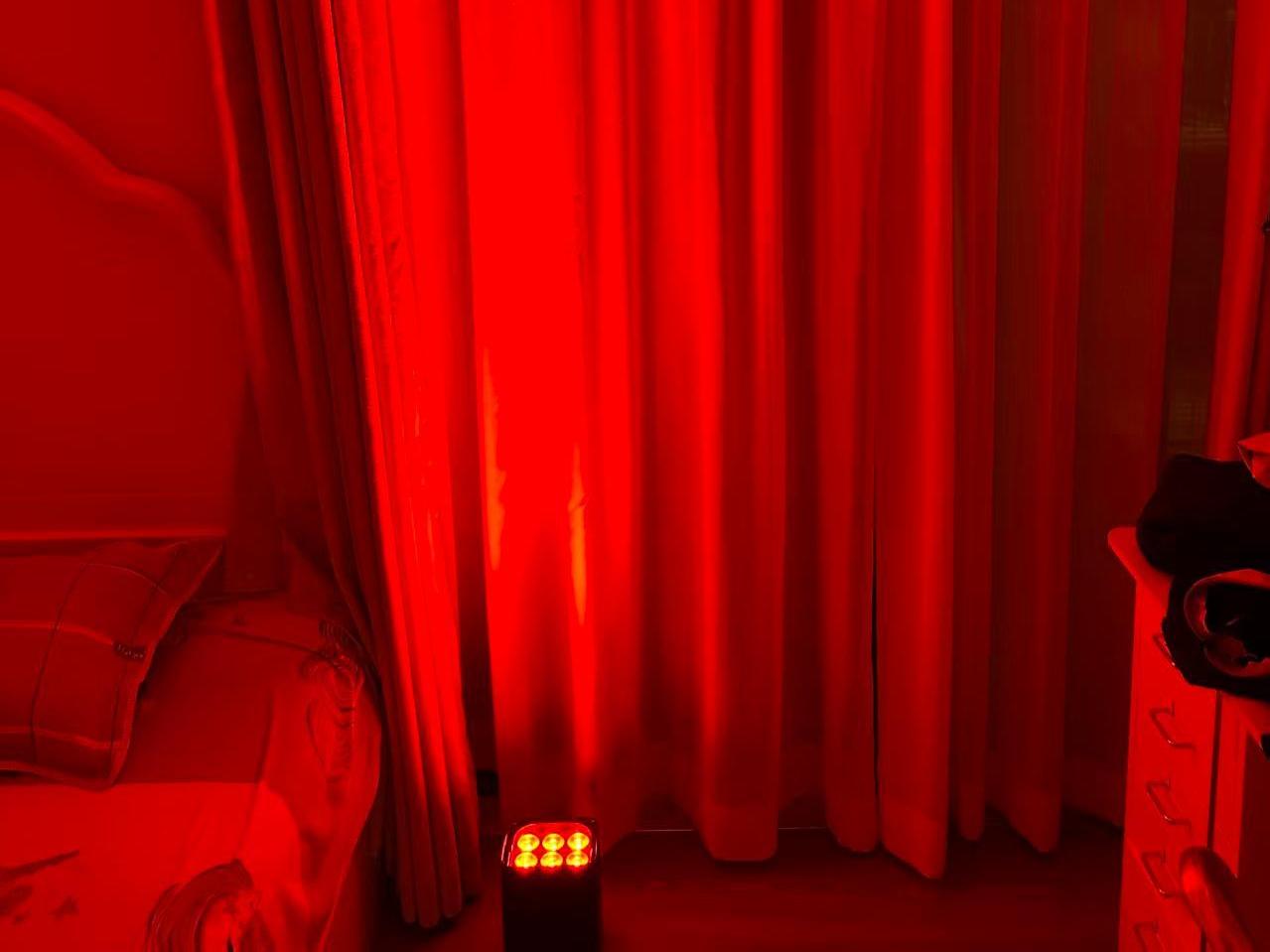
Table of Contents
A wired uplight needs an outlet within extension-cord range and a strip of gaffer tape across the floor. A battery powered uplighting fixture needs neither — set it down, power it on, and it runs on its own charge for the length of an event. That single difference is why battery operated uplights have gone from a niche rental add-on to the default choice on most event lighting quotes over the past several years.
This guide covers what these fixtures actually are, how battery operated uplighting and battery powered par can units work internally, the real specs that separate a good fixture from a disappointing one, and where to find deeper coverage of specific decisions — battery vs. wired, wedding planning, fixture formats — that get their own full treatment elsewhere on this site.
What Is Battery Powered Uplighting
Battery powered uplighting refers to LED fixtures that generate colored or white wash light from a self-contained rechargeable battery rather than a wall outlet. The fixture sits on the floor or a small stand, pointed upward, and washes color across a wall, column, or backdrop — the same visual role a wired par can fills, minus the power cord.
The terms battery operated uplights, battery operated uplighting, and led uplights battery operated all describe the same category of fixture — the word order and phrasing vary by how people search, not by any real difference in the product.
How Battery Operated Uplights Work
Three components determine how a fixture performs:
- LED engine — most modern units use RGBW or RGBWA+UV LED arrays, mixing red, green, blue, white, amber, and sometimes UV diodes for a wide color range, including cleaner pastels than older RGB-only fixtures could produce.
- Rechargeable battery — almost universally lithium-ion today, chosen for a better power-to-weight ratio and more charge cycles than older NiMH packs. Lithium-ion packs typically hold usable capacity for 500–800 full charge cycles before performance noticeably drops — for a fixture charged and used 2–3 times a week, that works out to roughly 3–5 years of service.
- Wireless control — built-in wireless DMX (commonly 2.4GHz) lets one transmitter group, color, and chase dozens of fixtures without a control cable running across the venue floor.
The wireless control architecture also determines how easy it is to manage a large install. Most professional battery uplighting systems use a master/slave or DMX zone model: one transmitter broadcasts to all fixtures in a group simultaneously, meaning color changes and chases apply across 10 or 50 units in the same instant, not one at a time. Confirm how many fixtures a single transmitter can reliably address — some systems cap out around 20 units per frequency band, which matters when planning a large venue install.
Tealshine’s Battery Powered Range: Output by Model
Output varies meaningfully across a battery powered lineup, and total wattage is the clearest single number for comparing that range at a glance.
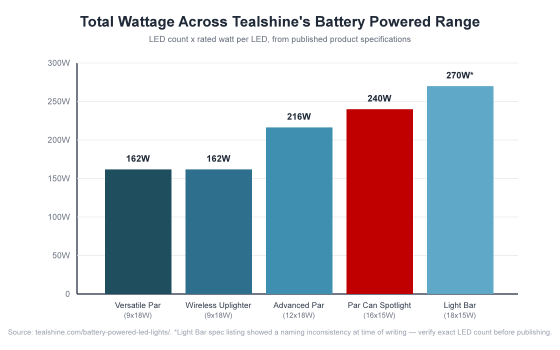
The 9×18W versatile par and 9×18W wireless uplighter sit at the entry point of the range, sharing the same LED configuration in two different housing styles. The 12×18W advanced par and 16×15W spotlight step up output for larger venues, and the 18×15W light bar covers linear wash coverage none of the par-style models are built for.
Battery Operated Uplighting vs. Wired: The Short Version
Battery wins on setup time, venue flexibility, and labor cost across many events. Wired wins on upfront price and unlimited runtime for long installs. The full breakdown — including a worked payback example for rental companies and an electrical planning table — lives in our dedicated battery vs. wired uplighting comparison.
Fixture Formats: Par Can, Uplighter, or Light Bar
Most battery powered par can buyers are actually choosing between two real formats: a par-style fixture for point-source wash, and a light bar for linear coverage along a stage edge or long wall. A separate “wireless uplighter” variant uses the same LED configuration as the entry-level par can in a different housing built for standalone placement. The complete breakdown of when each format fits — including where wall washers and pixel tubes fit into the broader picture — is covered in Types of Battery Powered Uplighting Fixtures.
Key Factors to Consider Before You Buy
Runtime. Ask for runtime at full brightness, not the “eco mode” figure vendors often lead with — a fixture rated for 15 hours in a spec sheet may only hit that number at 20% output. For all-day setup-to-strike events, look for a minimum of 8–10 hours at working brightness.
Brightness and beam angle. Lumen output determines visibility in a bright ballroom versus a dim tented reception. A narrower beam angle throws more concentrated color over a longer wall; a wider angle covers more area at closer range.
Wireless control range. Confirm the DMX range in an open venue — specs are often tested in ideal, obstruction-free conditions — and whether fixtures can be grouped into zones for larger jobs.
IP rating. If fixtures will ever sit outdoors, confirm IP54 or higher for dust and splash resistance. Indoor-only fixtures fail faster in humid or damp conditions, even under cover.
Charging setup. Removable batteries let you charge a second set while the first is deployed — useful for back-to-back bookings. Built-in batteries are simpler to manage but take the whole fixture out of rotation while charging.
Housing and build quality. A die-cast aluminum housing with a rubberized base handles years of loading, transport, and floor placement better than lightweight plastic shells.
Setup Time: What Battery Uplighting Actually Saves
The setup time advantage is real and measurable, not just a marketing bullet point. At roughly 1–2 minutes per fixture to position and power on, a 20-fixture reception setup takes around 20–40 minutes for one person — no cable runs, no gaffer tape, no circuit planning.
The same 20-fixture job with wired uplighting runs closer to 90–150 minutes for a two-person crew: each fixture needs a cable run back to an outlet, every cable needs to be taped down to prevent a trip hazard, and the crew needs to confirm no circuit is overloaded before powering up. Strike time follows the same ratio — pulling taped cable is slower than picking up a cordless fixture and walking it to a case.
| Battery Powered | Wired | |
| Setup time (20 fixtures) | 20–40 min, 1 person | 90–150 min, 2 people |
| Cable runs required | None | One per fixture |
| Gaffer tape needed | No | Yes — every cable on the floor |
| Circuit planning required | No | Yes — check load per circuit |
| Venue cord restrictions | Not applicable | Often restricted or prohibited |
IP Ratings and Outdoor Use
IP rating — Ingress Protection — is a two-digit number describing how well a fixture resists solid particles and water. The first digit covers dust (0–6); the second covers moisture (0–8). For battery powered uplighting specifically, two ratings matter:
- IP54 — protected against dust and low-pressure water splash from any direction. The practical minimum for any fixture that will ever sit outdoors, under a tent, or in humid conditions.
- IP65 — fully dust-tight and protected against low-pressure water jets. The standard for Tealshine’s full battery powered range, covering tented weddings, garden ceremonies, and outdoor festival setups.
An indoor-only (IP20) fixture left on damp grass, under light rain, or even in a heavily air-conditioned tent where condensation forms on cold surfaces will fail faster than its rated LED lifespan suggests — the moisture reaches the driver electronics before it ever affects the LED chips.
Where Battery Powered Uplighting Works Best
- Weddings and receptions — venues frequently prohibit taped cords on floors, and battery units let planners place light exactly where a design calls for it. For fixture counts by room size and color choices that photograph well, see our full wedding uplighting planning guide.
- Corporate events and galas — fast load-in/load-out windows favor cordless setups, especially in venues with strict cabling rules or a fire marshal who flags any cable crossing a public walkway.
- Outdoor and tented events — without reliable outlet access, battery power is often the only realistic option. Confirm IP65 rating before any outdoor booking.
- Rental companies with tight turnarounds — the labor time saved per job compounds across a season. At $30 per crew person-hour, 60–90 minutes saved on a 20-fixture setup is $30–45 per event — across 50 events a year, that is $1,500–$2,250 in recovered margin without adding a single booking.
Certifications to Verify Before Buying at Volume
For buyers purchasing in bulk or reselling under their own brand, certification is a compliance and liability issue, not just a quality signal. Verify these before placing a volume order:
- CE — required for import and sale in the European Economic Area.
- RoHS — restricts hazardous substances; required for CE marking and increasingly required by major retail buyers globally.
- FCC — required for wireless-enabled devices sold in the United States; covers radio frequency emissions from the wireless DMX module.
- IP65 (tested, not just claimed) — ask whether the IP rating is backed by a test report from a third-party lab.
All models in Tealshine’s battery powered range carry CE, RoHS, and IP65 certification. For OEM/ODM orders requiring custom compliance documentation, see our OEM/ODM services page.
Budget and Cost Factors
LED count, battery capacity, IP rating, control protocol, housing material, and certifications all drive price — and “budget” doesn’t have to mean unrated or underpowered if you know which specs matter most for your specific job. The full breakdown of what actually drives cost, including a supplier verification checklist, is covered in our budget battery powered uplighting guide.
Frequently Asked Questions
What’s the difference between battery operated uplights and battery powered uplighting?
Nothing functionally — both terms describe the same category of cordless, rechargeable LED wash fixtures. The phrasing difference is purely how people search, not a distinction in the product itself.
How long do battery powered uplights last on a single charge?
Most professional-grade fixtures run 8–15 hours at full brightness, depending on battery capacity and LED wattage. Always check the manufacturer’s rating at 100% output rather than the eco-mode figure.
How many charge cycles does a battery powered uplight last?
Most lithium-ion packs are rated for 500–800 full charge cycles before capacity noticeably fades — roughly 3–5 years of service for a fixture used 2–3 times a week.
Are battery operated uplights bright enough for large venues?
Yes, when spec’d correctly. Look for fixtures in the 12W–18W-per-LED range with RGBW LEDs for ballrooms and larger spaces; smaller rooms can often use lower-wattage units without losing visual impact.
Can battery powered uplighting be used outdoors?
Yes, provided the fixture carries an IP54 rating or higher. Always check the rating before booking an outdoor job — an indoor-only fixture left in damp grass or light rain can fail mid-event.
Final Thoughts
Battery powered uplighting has become the default choice for a reason: it removes the biggest logistical headache in event lighting — cable management — without asking planners to compromise on color or coverage. The gap between a fixture that performs and one that disappoints comes down to the details covered above: real-world runtime, honest brightness figures, and build quality that survives repeated use.
Browse Tealshine’s battery powered lighting range, or get in touch about OEM/ODM options for custom brightness, color mixing, or housing specifications.