Professional High Quality Stage Lighting Manufacturer


Table of Contents
Battery operated uplighting costs more per fixture. Wired uplighting costs more in labor. That trade-off — not “which is better” — is the actual decision most event professionals are making, and the right answer changes depending on the venue, the crew size, and how many times the fixture gets used.
This article runs the numbers on both sides: setup time, real cost over the life of a fixture, venue restrictions, and where each option actually wins.
The Core Difference
Battery operated uplighting runs on an internal rechargeable battery — no power cord, no outlet needed. Wired uplighting pulls continuous power from an outlet or extension cord. That’s the entire technical difference. Everything else in this comparison — cost, setup time, venue rules — follows from that one fact.
Setup Time: A Worked Example
Take a common job: 20 uplights around a 100-guest reception, columns and wall panels spaced evenly around the room.
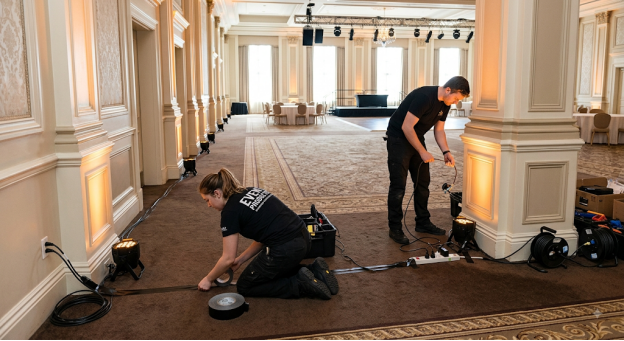
Wired setup, per fixture:
- Position the fixture and run a cable back to the nearest outlet or a daisy-chained power strip.
- Tape the cable down with gaffer tape along the walkway or baseboard — required in most venues to avoid a trip hazard.
- Confirm no circuit is overloaded once multiple fixtures share one outlet.
At roughly 5–8 minutes per fixture including cable run and taping, 20 fixtures with a two-person crew takes somewhere around 90–150 minutes of load-in time, before accounting for circuit planning.
Battery setup, per fixture:
- Position the fixture. Power it on.
At roughly 1–2 minutes per fixture, the same 20 fixtures take around 20–40 minutes for one person to place, with no cable planning at all.
Strike time follows the same ratio in reverse — pulling taped cable is slower than picking up a fixture and walking it to a case. Over a full event, battery uplighting typically saves 60–100+ minutes of combined load-in and strike time on a 20-fixture job.
Cost: What You’re Actually Paying For
Battery fixtures cost more upfront. The battery pack, charging circuitry, and wireless DMX receiver all add manufacturing cost that a wired fixture doesn’t carry. That gap is real and worth acknowledging rather than glossing over.
What narrows the gap over time:
- Consumables — gaffer tape and extension cords are a real, recurring per-event cost for wired setups. A roll of gaffer tape doesn’t survive many strikes; it gets bought again and again.
- Labor — if a crew bills $25–40 per person-hour, the 60–100 minutes saved per job on a 20-fixture setup adds up to real money saved across a season of events, not just a convenience.
- Battery lifespan — lithium-ion packs typically hold usable capacity for 500–800 full charge cycles before performance noticeably drops. For a rental company running fixtures 2–3 times a week, that’s roughly 3–5 years of service before batteries need replacing — a cost wired fixtures never carry, but one that’s smaller than most buyers expect.
The practical takeaway: a single wedding favors whichever fixture is already on hand. A rental company running dozens of events a year should model the labor savings against the upfront premium — for many crews, battery fixtures pay back that premium within the first year of steady use.
A Worked Payback Example
Say a rental company buys 20 battery fixtures at a premium of roughly $40 per unit over an equivalent wired model — an $800 total difference across the set. If battery uplighting saves 90 minutes of combined load-in and strike time per job, and the crew bills at $30 per person-hour across two people, that’s $90 saved in labor per event.
At that rate, the $800 premium pays back in roughly 9 events. A company running two uplighting jobs a week clears that payback period within a single month of active use — after which every job’s labor savings is pure margin. A company running one or two uplighting jobs a year may never fully recover the premium through labor savings alone, and should weigh venue flexibility instead.
Electrical Planning for Wired Setups
Wired uplighting adds a planning step battery fixtures skip entirely: circuit capacity. A standard 15-amp circuit at 120V supports roughly 1,800 watts before tripping a breaker, and code-compliant practice generally keeps continuous loads to 80% of that — around 1,440 watts of headroom per circuit.
A bank of ten 18W LED par cans draws only about 180 watts total, well within a single circuit’s capacity — but the venue’s outlet layout, not the fixtures’ draw, usually decides how many circuits a wired job actually needs. Confirm outlet locations and shared circuits with venue staff before finalizing a wired uplighting plan, particularly in older buildings where several outlets often share one breaker.
Venue Rules and Safety Considerations
Many venues restrict or flatly prohibit taped cable runs across walkways, particularly historic buildings, hotel ballrooms, and any space with strict fire marshal oversight. Cable crossing a public path is generally treated as a trip hazard and an egress concern under local fire code — always confirm the specific venue’s policy in advance rather than assuming a wired setup will be approved.
Battery fixtures sidestep this entirely: no cable means no egress conversation with venue staff or a fire marshal walkthrough before doors open.
Runtime and Reliability
Wired uplighting runs indefinitely — as long as the outlet has power, the fixture works. Battery uplighting is bounded by charge: most professional-grade fixtures run 8–15 hours at full brightness, which covers a typical event day but leaves little margin for a multi-day install without recharging.
For multi-day trade shows or week-long installs, wired fixtures remove the recharging variable entirely. For a single evening event, a fully charged battery fixture has no realistic runtime disadvantage.
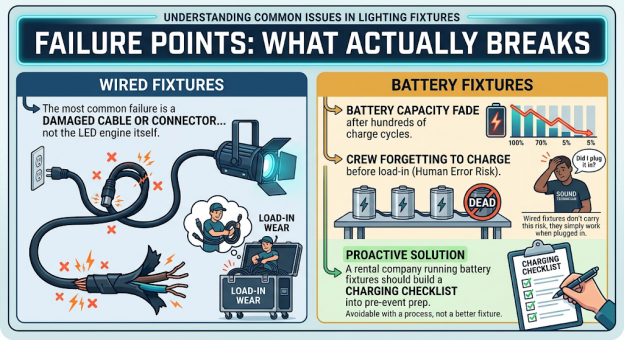
Failure Points: What Actually Breaks
Each option fails differently, and knowing the common failure point matters more than knowing which option is more “reliable” in the abstract.
- Wired fixtures — the most common failure is a damaged cable or connector from repeated coiling, tape removal, and load-in wear, not the LED engine itself.
- Battery fixtures — the most common failure is battery capacity fade after hundreds of charge cycles, or a crew forgetting to charge a unit before load-in — a human error risk wired fixtures don’t carry, since they simply work once plugged in.
A rental company running battery fixtures should build a charging checklist into pre-event prep specifically because that failure mode is procedural, not mechanical — it’s avoidable with a process, not a better fixture.
Decision Table: Which Fits Your Job
| Scenario | Recommended |
| Historic venue that prohibits taped cable runs | Battery |
| Outdoor tented wedding with no nearby power | Battery |
| Ballroom with outlets already positioned near each uplight spot | Wired (lower upfront cost, no clear battery advantage) |
| Multi-day trade show or week-long install | Wired (no recharging downtime) |
| Rental company running frequent, fast-turnaround events | Battery (labor savings compound over many jobs) |
| One-off budget-conscious event with crew already on-site for hours | Wired (setup time cost matters less) |
For the full spec breakdown on choosing a battery fixture once you’ve decided that’s the right direction, see our battery powered uplighting buying guide.
Frequently Asked Questions
Is battery operated uplighting bright enough to replace wired fixtures?
Yes, at comparable wattage. Brightness depends on LED count and power draw, not on whether the fixture is battery or wired — a well-specified battery fixture matches a similarly rated wired one.
How much more does battery operated uplighting cost upfront?
It varies by manufacturer and specification, but the battery pack, charging circuitry, and wireless DMX receiver typically add a meaningful premium over an equivalent wired fixture. Request quotes on matched specs to compare accurately.
Can I mix battery and wired uplighting at the same event?
Yes, and it’s common — battery fixtures in areas without power access or where cable runs aren’t allowed, wired fixtures where outlets are already convenient, both synced over the same wireless DMX network.
Do battery uplights lose brightness as the charge runs down?
Most professional fixtures hold consistent brightness until the battery nears empty, then dim or shut off rather than fading gradually — check the specific model’s discharge behavior if a long event day is planned close to the fixture’s rated runtime.
Final Thoughts
Neither option wins outright. Battery operated uplighting wins on setup time, venue flexibility, and labor cost across many events. Wired uplighting wins on upfront price and unlimited runtime for long installs. Run the numbers for your actual job frequency and crew cost before defaulting to whichever fixture is already in the case.
Browse Tealshine’s battery powered uplighting range or wired par can lights to compare specs side by side, or get in touch about OEM/ODM options for bulk rental inventory.