Professional High Quality Stage Lighting Manufacturer


Table of Contents
Search “types of uplighting fixtures” and you’ll usually find a list that mixes wired and battery powered options together — wall washers, pixel tubes, pin spots, par cans — as if they’re all interchangeable. Narrow that list down to fixtures that are actually built to run on battery power, and the real choice comes down to far fewer options. Here’s what those formats actually are, what each one is built for, and which one fits your event.
The Core Battery Powered Formats You’ll Actually Buy
Most battery powered uplighting fixtures on the market today fall into two practical categories: compact par-style uplighters, and linear light bars. Everything else in the wider “uplighting” conversation — wall washers, pixel tubes, pin spots — exists mainly as wired equipment, for reasons covered further down.
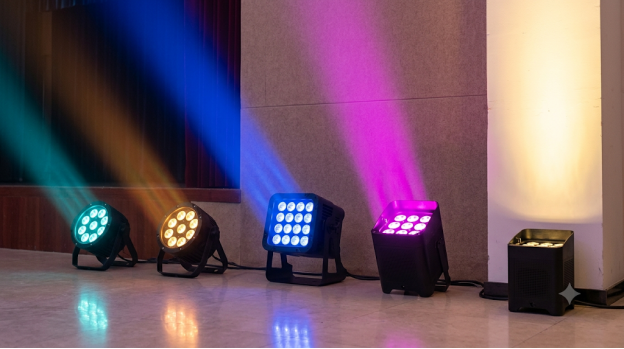
1. Battery Powered Par Can / Uplighter Fixtures
This is the workhorse format — a compact cylindrical or box-style fixture that sits on the floor and washes color upward across a wall, column, or backdrop. Within this format, the main variable is LED count and wattage, which determines brightness and beam coverage rather than changing how the fixture is used.
Tealshine’s range spans this exact tradeoff: the 9×18W battery powered par can covers most standard event uplighting, the 16×15W spotlight steps up output for larger rooms, and the 12×18W model sits at the top for jobs needing maximum brightness. A closely related wireless uplighter variant — uses the same 9×18W LED configuration in a dedicated uplighter housing, useful when a project calls for a standalone fixture rather than a full par-can set.
2. Battery Powered Light Bars
Where par cans point a single wash upward, battery powered light bars spread LEDs along a linear housing — better suited to lighting stage edges, truss runs, or long walls where a single par can’t cover the full span without gaps. Tealshine’s outdoor battery powered light bar fills this role, carrying the same IP65 and wireless DMX standards as the par can lineup.
Other Uplighting Formats You’ll See — and Why They’re Usually Wired
Wall washers, pixel tubes, and pin spots all technically fall under the broader “uplighting” umbrella, but you’ll rarely find true battery powered versions of them at a professional level. Wall washers and pixel tubes are typically run at higher continuous output for large-scale coverage or gradient effects, which draws more current than a battery pack can sustain for a full event without frequent swaps. Pin spots, by contrast, are usually mains-powered because they’re often left running for an entire event on a single decor item rather than repositioned like a portable uplight.
If your project needs true wall-wash coverage rather than a compact uplight, that’s a separate product category — Tealshine’s wall wash lighting line — worth comparing against a par can lineup before assuming battery power is the right fit for that specific job.
Which Format Fits Your Event
- Wedding and reception backdrops, columns, floral arrangements — par can uplighters, sized by room brightness needs.
- Stage edges, DJ booth fronts, truss-mounted runs — light bars for even linear coverage.
- Standalone accent lighting where only one or two fixtures are needed — the wireless uplighter variant, since it doesn’t require matching a full par-can set.
- Large architectural facades or continuous wall coverage — wired wall wash fixtures rather than battery uplighting.
Features to Check Regardless of Format
Whichever format fits the job, the same core specs decide whether the fixture actually performs: real-world runtime at full brightness, IP rating for outdoor use, wireless DMX range, and housing build quality. Our full buying guide breaks down each of these factors in more detail if you’re comparing specific models.
Frequently Asked Questions
What’s the difference between a par can uplighter and a light bar?
A par can throws a single, adjustable-beam wash from one point, ideal for columns, corners, and backdrops. A light bar spreads LEDs across a linear housing, better suited to covering long, continuous surfaces like a stage edge or truss run without visible gaps between fixtures.
Do I need a light bar or a par can for wall wash coverage?
For a single wall or column, a par can is usually enough. For a long continuous wall or facade, a light bar (or a dedicated wired wall washer for larger-scale jobs) gives more even coverage with fewer visible hotspots.
Can different uplighting formats be mixed in the same event setup?
Yes, and it’s common — par cans for backdrops and columns, light bars for stage edges or truss, run together over the same wireless DMX network so they can be color-matched and controlled as one system.
Are wireless uplighters as bright as full par can fixtures?
It depends on the LED configuration rather than the format itself — a 9×18W wireless uplighter and a 9×18W par can will output similarly; brightness comes down to wattage and LED count, not which housing style it’s built into.
Final Thoughts
Most of what gets labeled a battery powered uplighting fixture online actually narrows down to two practical formats — par can uplighters and light bars — with everything else in the broader uplighting category typically staying wired for good technical reasons. Matching the format to the actual surface you’re lighting matters more than chasing extra fixture types you likely won’t need.
Browse Tealshine’s full battery powered lighting range to compare formats side by side, or get in touch for OEM/ODM options on bulk orders.