Professional High Quality Stage Lighting Manufacturer



Table of Contents
Pick the wrong moving head lights for a job and the problem usually isn’t brightness — it’s the wrong type of output for the room and the effect you actually need. A beam moving head light that reads beautifully in a haze-filled festival tent looks like a small bright dot in a dry banquet hall. A wash fixture that covers a stage perfectly at 6 meters becomes a blinding, overexposed mess at 2 meters in a DJ booth. The type of moving head light fixtures matters far more than the wattage number on the spec sheet.
This guide covers what separates beam, wash, and wave bar formats at a mechanical level, how to choose between them for specific jobs, what dj moving head lights actually need to perform reliably in a mobile setup, and which specs predict real-world performance versus which ones are marketing noise.
Three Formats, Three Different Jobs
Every moving head light on the market belongs to one of three working formats. The format isn’t just a shape difference — it’s a fundamentally different optical design built to do a different job.
Beam: Tight Shaft, Long Distance
A beam moving head light uses a small-diameter lens and a single concentrated LED source to produce a nearly parallel shaft of light that holds its shape over long distances. “Collimation” — the optical property that keeps light rays traveling in the same direction instead of spreading — is what makes a beam look punchy at 20 meters while a wash fixture at the same distance has already fanned out and lost intensity.
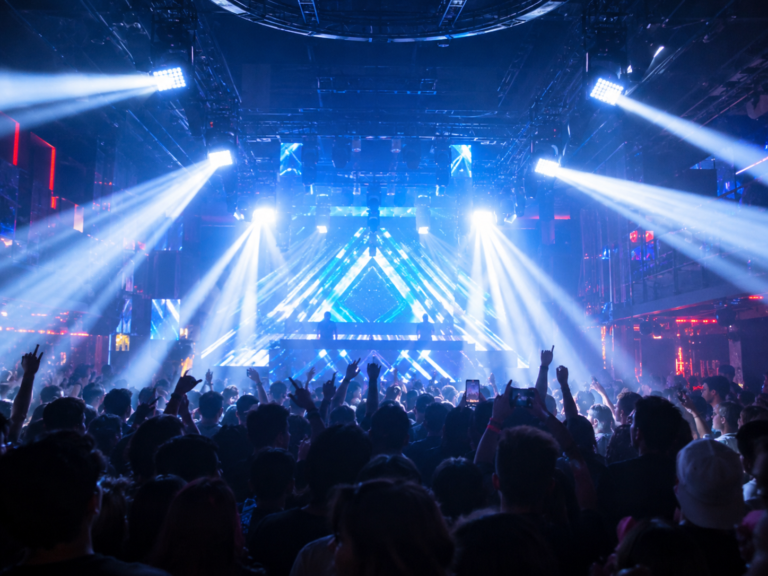
The trade-off is coverage. A 3°–5° beam covers a tiny footprint at any distance, which means it reads as a sharp aerial effect or a single accent point, not a wash across a backdrop. Haze in the air is what makes the beam shaft itself visible rather than just a bright dot on whatever surface it hits — beam fixtures without atmospheric haze are mostly wasted in an indoor venue.
Beam fixtures also run hot relative to their size. A single high-intensity LED source concentrates heat in a small area, which is why beam fixtures typically carry larger heat sinks and more aggressive cooling fans relative to their housing than wash fixtures of similar wattage.
Wash: Even Coverage, Movable
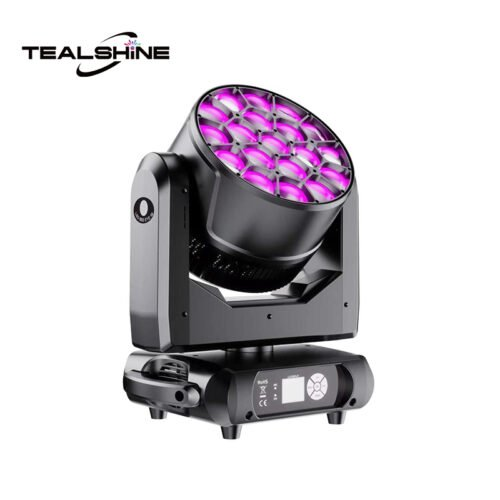
A wash moving head spreads light across a wide surface using a multi-lens array — often a “bee eye” configuration, where many small lenses each focus a portion of the total LED output, and the combined result is a wide, soft-edged wash rather than a shaft. The effect is the same job a fixed par can does, with the key difference that a wash head can reposition mid-show under DMX or sound-active control.
Wash fixtures are the more versatile all-rounder. At short throw distances (2–4 meters in a club or DJ booth), a wider beam angle covers a booth face or wall section without leaving dark gaps. At longer distances on a stage, a motorized zoom wash can narrow its angle to cover a specific section precisely or widen to wash the full width.
The downside versus a beam: wash output looks soft rather than punchy. In a dark club or a haze-heavy show, that reads as atmospheric and rich. In a bright or dry venue, the same wash can look underwhelming against ambient light because the output spreads rather than concentrating.
Wave Bar / Hybrid Beam Bar: Both Effects, One Fixture
The led moving head wave bar light format is a newer category — a motorized moving head built around a linear bar of individual beam lenses rather than a single head or a multi-lens wash array. The result is a fixture that can produce individual beam shafts from each lens, a coordinated sweep effect as the bar tilts and pans, and a secondary ring-strip or halo light source on some models.
Tealshine’s 12×40W RGBW moving beam bar with ring strip puts 12 individual 40W beam lenses in a linear bar with a motorized mount, producing a total of 480W across the array. Each of the 12 lenses can be addressed individually for pixel-chase effects, or they can fire together as a coordinated beam bank. The ring-strip secondary source adds a glowing accent halo around the bar that’s visible even when the beam lenses aren’t in use — a hybrid look that doesn’t require two separate fixtures.
Output Across Tealshine’s Moving Head Range
Total wattage gives a rough proxy for maximum output, though beam angle, optic quality, and LED efficiency all affect how that wattage actually reads in a room. The chart below shows wattage across every current model in the range.
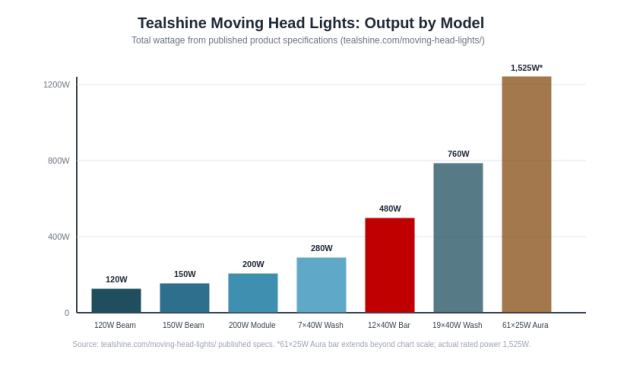
The 61×25W Aura wash sits well above every other model at 1,525W — built for large venue wash coverage rather than a typical touring or DJ rig. The 12×40W wave bar at 480W sits between the beam and mid-range wash options, which reflects its dual-format design: more output than a single beam head, but less total power than a high-end wash array.
What DJ Moving Head Lights Actually Need
A dj moving head lights setup differs from a touring stage rig in four specific ways that most general-purpose fixture selection guides don’t address:
Weight and Portability
A mobile DJ loads in and out alone or with one other person, carries fixtures in a vehicle, and mounts them on lightweight tripod stands rather than a crew-rigged truss. A 150W beam fixture in the 8–10kg range is manageable for that workflow. The 61×25W Aura wash at its full weight is not — it’s a venue installation fixture, not a mobile DJ rig.
For a dj moving head light pair as a starting kit, the 120W or 150W beam models paired with the 7×40W bee eye wash zoom gives one sharp aerial effect fixture and one wash fixture per side of a booth — manageable weight, two distinct visual layers, and a straightforward two-fixture DMX patch.
Standalone Control Without a Console
Most moving heads dj lighting setups don’t run a full DMX console every night. Sound-active mode — where a built-in microphone triggers movement and color changes from the audio signal — covers the majority of club and mobile DJ nights without programming. Master/slave linking mirrors one fixture’s behavior to the others without a controller, which handles a two- or four-fixture setup in sync without patching a thing.
DMX control matters for special events, residencies, or any show where a specific cued look justifies the programming time. The practical approach most working DJs land on: master/slave or sound-active for regular nights, DMX programming for higher-production events where the rig is used repeatedly.
Fan Noise in Quiet Environments
Higher-output fixtures run louder cooling fans, and in a small indoor venue or a quiet ceremony setting, the cooling fan from a bank of moving heads dj lights running at maximum output can be audible. Lower-wattage beam models generally run quieter fans than wash fixtures with higher total LED counts. If fan noise is a concern for a specific venue, check whether the manufacturer publishes a noise rating and whether the fixture has a “silent” or reduced-speed fan mode for lower-output operation.
Thermal Throttling on Long Sets
A moving head fixture run at maximum brightness for three to four continuous hours — a common scenario for a DJ set plus a following party — can hit its internal thermal limit and reduce output to protect the LED and driver components. This shows up as a gradual dimming that’s easy to miss in a busy venue but real. Confirm the fixture’s continuous duty cycle at full output before committing to it for long-run events, not just for short show segments.
The LED Moving Head Wave Bar Light: A Deeper Look
The led moving head wave bar light format has grown rapidly in the DJ and club lighting market because it gives a single fixture three visual modes that would otherwise require separate fixtures:
- Coordinated beam bank — all 12 lenses firing together produces a wide, multi-shaft effect that reads differently from a single-head beam fixture — more like a linear blade of light across the air rather than a single shaft.
- Pixel chase — individual addressing of each of the 12 lenses lets the bar run rolling, chasing patterns across its length in sync with music or a DMX cue — an effect impossible with a conventional single-head fixture.
- Halo accent — the secondary ring-strip source provides continuous ambient glow even when the beam lenses aren’t actively firing, which means the fixture has a visual presence in the room between active cues rather than going dark.
The 12×40W configuration runs 480W total at full output across all lenses. At a typical DJ booth ceiling of 2.5–3 meters, the linear beam pattern sweeps across a floor or wall in a distinctly different way from a single-head beam fixture — the 12 discrete shafts spread across a wider horizontal span, creating a “wave” effect as the bar tilts that gives the format its name.
Matching the Right Fixture to the Job
| If you need… | Format | Tealshine model |
| Tight aerial effects that cut through haze at long distance | Beam | 200W Module Beam |
| Mobile DJ two-fixture starting kit (pair) | Beam × 2 | 120W or 150W Beam (pair) |
| Even movable backdrop wash for a stage | Wash | 19×40W Bee Eye Wash Zoom |
| DJ booth short-throw wash (2–3m) | Wash (compact) | 7×40W Bee Eye Wash Zoom |
| Linear wave bar + pixel chase + halo in one fixture | Wave Bar | 12×40W RGBW Moving Beam Bar |
| Large venue full-stage wash, permanent install | Wash (large) | 61×25W Aura Wash |
Specs That Predict Real Performance
Pan and tilt range. A standard moving head covers 540° of pan and 270° of tilt. Some compact fixtures reduce this range for weight savings — check the actual degrees rather than assuming, since a narrower range limits the positioning options for ceiling-mounted or truss-flown fixtures.
Motor speed. Smaller motors move slower. A fixture with a 2-second full-pan time responds differently to music-synced chase effects than one that covers the same range in 0.8 seconds. Ask for motor speed figures in seconds-per-full-range if fast movements are part of the planned show.
DMX channel count and modes. More channels means finer control over individual parameters — separate R/G/B/W channels, individual lens addressing on a wave bar, or 16-bit precision for smoother movement. More channels also means more complex patching. Confirm the fixture offers a reduced-channel mode for simpler setups alongside the full-channel mode for programmed shows.
Gobo wheel. Beam and spot fixtures sometimes include a rotating gobo wheel for pattern projection — logos, shapes, geometric patterns. Tealshine’s current beam and wash range focuses on pure beam and wash output without gobo wheels; if projected patterns are needed, that’s worth flagging with the team as an OEM/ODM specification rather than assuming a standard beam fixture covers it.
IP rating. All of Tealshine’s current moving head models carry an IP20 rating — built for indoor use. If a moving head fixture will ever run outdoors (festival stages, open-air venue rooftops, tented events), confirm with the manufacturer whether an outdoor-rated version is available before ordering indoor-rated inventory for outdoor use.
A Practical DJ Rig Setup: Two Configurations
Configuration A: Entry-Level Mobile DJ (2 Fixtures)
- 2 × 120W LED beam moving heads — one per side of the booth, mounted on lightweight tripods, run in sound-active mode synced as master/slave.
- What this covers: aerial beam effects, color chases timed to music, symmetrical look without a console. Total weight around 16–20kg including stands and cases.
- What this doesn’t cover: wash coverage behind the DJ booth face, halo or pixel-bar effects, or wide wash across the dance floor.
Configuration B: Production DJ / Club Install (4–6 Fixtures)
- 2 × 150W beam moving heads (front truss or tripod stands) — aerial effects over the dance floor.
- 2 × 7×40W bee eye wash zoom (back truss or wall mount) — movable wash across the booth backdrop or DJ wall.
- 1 × 12×40W wave bar (center truss or ceiling mount) — pixel-chase wave bar effect as a visual centrepiece.
- What this covers: three distinct visual layers, DMX or sound-active programmable, full show capability without additional fixture categories.
Frequently Asked Questions
What is the difference between a moving head light and a fixed par can?
A par can stays fixed once positioned — it washes one area for the whole event. A moving head repositions its beam during a show via motorized pan and tilt, letting one fixture cover multiple positions, chase effects, and programmed movement that a fixed fixture can’t do.
Are beam or wash moving heads better for a DJ setup?
Most DJ setups benefit from both rather than choosing one: beam fixtures for aerial effects and dance floor sweeps, wash fixtures for backdrop and booth coverage. If only one type is possible, wash fixtures are more versatile at close range (2–4 meters) where beam fixtures produce overly concentrated hotspots.
What does “dj moving head light pair” typically mean?
It usually refers to two identical fixtures sold or used together in a symmetrical booth setup — one per side. Running a matched pair in master/slave mode gives synchronized movement and color without a DMX console, which is why pairs are the standard starting configuration for mobile DJs.
How many DMX channels do moving head lights typically use?
Between 8 and 30+ channels depending on the fixture and mode. A basic beam fixture in simplified mode might use 8–10 channels covering pan, tilt, color, and strobe. A 12-lens wave bar in full individual-addressing mode can use 20–30+ channels for per-lens control. Most professional fixtures offer multiple channel modes so simpler setups don’t require patching every parameter.
Can moving head lights run without a DMX console?
Yes. Most include sound-active mode (music-triggered effects), auto-run mode (preset patterns), and master/slave linking (mirror one fixture to others). DMX control unlocks precise programming and cued movement, but it isn’t required for basic operation.
What is an LED moving head wave bar light?
A moving head wave bar is a motorized fixture built around a linear bar of individual beam lenses rather than a single head. The bar tilts and pans as a unit while individual lenses can be addressed separately for pixel-chase effects. The result is a wave or sweep pattern as the bar moves — different from both a conventional beam head and a wash fixture.
How many moving head lights do I need for a DJ setup?
Two is the minimum for a symmetrical look (one per side of the booth). Four to six covers most production DJ setups with multiple fixture types: two beam fixtures for aerial effects, two wash fixtures for backdrop coverage, and optionally a wave bar as a centrepiece. Full fixture count guidance by room size is covered in our venue lighting count guide.
Final Thoughts
The most common mistake when buying moving head lights is choosing on wattage rather than format. A 200W beam fixture and a 200W wash fixture are completely different tools — one throws a tight shaft over long distances, the other spreads even coverage at close range. Know which visual effect you’re actually after before looking at any other spec.
For DJs and mobile production setups, weight, standalone control modes, and thermal performance over long sets matter as much as raw output. For fixed club or venue installs, motor speed, duty cycle, and service accessibility become the long-term considerations.
Browse Tealshine’s full moving head lighting range to compare all models side by side, or get in touch about OEM/ODM options for custom beam angles, DMX profiles, or housing specifications for larger orders.