Professional High Quality Stage Lighting Manufacturer


Table of Contents
The short answer: one battery powered uplighting fixture every 8–10 feet along your venue’s perimeter walls, with 10–20% overlap between each fixture’s coverage area. For a 100-guest reception in a medium ballroom, that works out to 16–24 battery operated uplights. For a 50-person event in a small venue, 6–10 fixtures usually covers the room. For a ceremony arch only, 4–6 fixtures is typically enough.
Those numbers come from a simple formula, not a guess. The rest of this guide shows the math behind them, how to adjust for your specific room, and where most buyers go wrong by over- or under-ordering.
The Spacing Formula: Where These Numbers Come From
The formula behind every uplight count recommendation is coverage overlap, not guest count. A fixture’s coverage width at a given distance determines how far apart you can space fixtures before gaps appear in the wash.
Beam angle controls coverage width. At a standard 25°–40° fixture aimed from floor level at a wall 2–3 meters away, each unit covers roughly 1–2.5 meters of wall surface. Space them so each fixture’s coverage overlaps its neighbor by 10–20% and you get a continuous, even wash. Space them further apart and you start to see dark seams between cones of light.
| Beam Angle | Coverage at 2m distance | Coverage at 3m distance | Max spacing (10% overlap) |
| 25° | ~0.9m | ~1.3m | ~8 ft |
| 40° | ~1.4m | ~2.2m | ~12 ft |
| 60° | ~2.3m | ~3.5m | ~18 ft |
Trigonometric planning estimates (2 × distance × tan(angle ÷ 2)). Confirm actual coverage on-site — walls, columns, and drapery change how a beam reads in practice.
The rule of thumb that flows from this: for most standard fixtures at typical indoor mounting distances, plan for one fixture every 8–10 feet along the wall run you’re washing. That’s conservative enough to account for beam variation between fixture models without getting into per-model trigonometry for every job.
Recommended Counts by Venue and Event Type
The chart below shows the recommended minimum and comfortable range for the most common event scenarios.
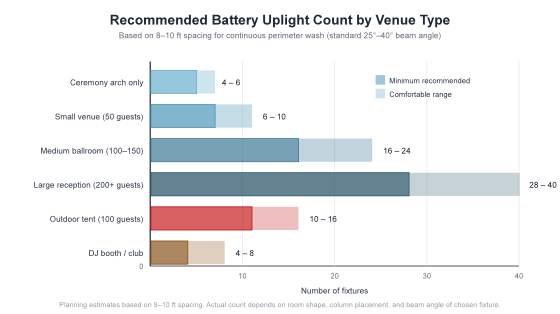
Ceremony Arch Only: 4–6 Fixtures
A ceremony arch or altar doesn’t need a full perimeter wash — it needs accent uplighting that frames the structure without washing out the couple standing in front of it. Position 2–4 fixtures behind or to the sides of the arch for backlighting, and 2 more at the aisle entrance to mark the processional start. Angling slightly outward rather than straight up prevents fixtures from shining directly into guests’ eyes from seated positions.
Small Venue (50 Guests): 6–10 Fixtures
A small venue — a restaurant private room, a boutique hotel space, or a smaller banquet hall — typically runs 80–120 feet of usable perimeter wall. At one fixture every 10 feet, 8–12 fixtures covers the full run. The lower end of the range (6 fixtures) works if the room has significant architectural features like large windows or built-in millwork that break up the wall and don’t need uplighting.
Medium Ballroom (100–150 Guests): 16–24 Fixtures
A standard medium ballroom for 100–150 guests usually runs 160–240 feet of perimeter wall. At one fixture every 10 feet with 10–20% overlap, 16–24 fixtures covers a full perimeter wash. The lower end of the range (16 fixtures) works for a simpler look with slightly more space between cones; the upper end (24) produces a denser, more saturated wash that reads better on camera.
Large Reception (200+ Guests): 28–40 Fixtures
A large ballroom or event hall for 200+ guests can run 280–360 feet or more of total wall perimeter. The fixture count climbs accordingly. For events at this scale, it’s worth walking the room and counting the usable wall sections specifically — large ballrooms often have service doors, kitchen entrances, and built-in bars that eat into what looks like a continuous wall run on a floor plan.
Outdoor Tented Event (100 Guests): 10–16 Fixtures
An outdoor tent doesn’t have rigid walls to wash — the uplighting goal shifts to accenting tent liner fabric or framing the entrance structure. The coverage need is genuinely smaller than an equivalent indoor reception because you’re not trying to eliminate dark wall sections. 10–16 fixtures typically handles a 40×60-foot tent comfortably, positioned along the tent’s perimeter poles and entrance.
Outdoor use also means confirming IP rating before ordering. Any fixture sitting outside in an unsealed tent should carry at least IP54 for dust and splash resistance — full fixture spec guidance is in our battery powered uplighting buying guide.
DJ Booth / Small Club: 4–8 Fixtures
A DJ booth or small club install uses uplighting as accent and atmosphere rather than full perimeter coverage. 4–6 fixtures behind and alongside the booth face, aimed at the booth structure or the back wall behind the DJ, covers the visual impact without over-lighting a space where the energy is meant to come from the performance and sound rather than the walls.
The Two Most Common Mistakes: Too Few and Too Many
Ordering Too Few
The most visible consequence of under-ordering is a striped or patchy wash — alternating light and dark sections where fixture coverage doesn’t overlap. It reads clearly in photos and is difficult to fix on the night without adding fixtures you don’t have. The instinct to save cost by shaving a few units off the recommended count almost always shows up visibly in the final result.
A secondary effect: under-lit rooms often prompt the planner to compensate by running fixtures at maximum brightness, which shortens runtime per charge and can put fixtures in an overheating risk zone on long event days.
Ordering Too Many
Over-ordering is less visually obvious but more expensive. Beyond a certain density — fixtures every 4–5 feet — coverage overlaps so heavily that adding another unit doesn’t change the visible result. The wash is already continuous and saturated; the extra fixtures just add cost, weight, and charging logistics without a visible return.
The sweet spot is 10–20% overlap between adjacent fixture beams. At that density, the wash is continuous without redundant overlap.
How to Calculate the Right Count for Your Room
Three steps, no guesswork:
- Step 1: Measure or estimate the usable perimeter wall length in feet — the sections you actually want to wash, not counting service doors, kitchen entrances, or areas blocked by furniture.
- Step 2: Divide that total by 9 (a safe midpoint of the 8–10 foot spacing rule) to get your baseline fixture count.
- Step 3: Add 10–15% as a buffer for columns, nooks, or sections where a single fixture doesn’t reach fully. Round up to the nearest whole fixture.
Example: 180 feet of usable wall ÷ 9 = 20 fixtures as a baseline. Add 15% buffer = 23 fixtures. Round up to 24.
Walk the room at the same time of day the event will actually run whenever possible — natural light from windows affects how visible a color wash is, and changes the perceived count needed between an afternoon ceremony and an evening reception in the same venue.
Related Decisions Once You Have the Count
Once you know how many fixtures you need, three follow-on questions come up on most jobs:
- Battery vs. wired — if the venue has outlets near each wall section, wired fixtures are cheaper upfront; if not, battery is the practical choice. Full cost comparison in our battery vs. wired uplighting comparison.
- Rent vs. buy — whether owning a set at your target count makes financial sense depends on how often you use them.Rent or buy guide runs the break-even math.
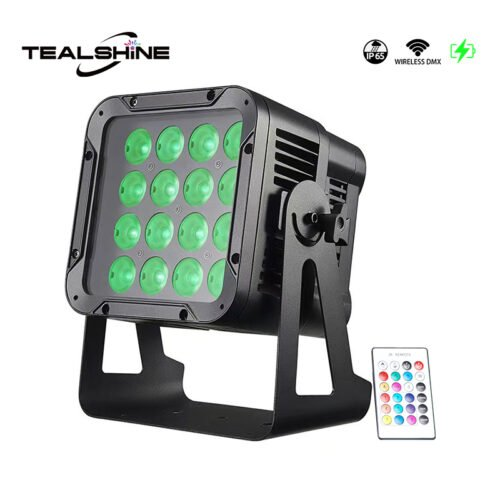
- Which model — for most standard perimeter washes, the 9×18W or 12×18W fixtures in Tealshine’s range cover typical ballroom and reception needs; the 16×15W spotlight steps up for larger venues needing more throw distance. Browse the full battery powered lighting range to compare specs.
Frequently Asked Questions
How many uplights do I need for a 50×50 ft venue?
A 50×50 ft room has a perimeter of 200 feet. At one fixture every 9 feet on the usable walls (subtracting doors and built-in elements), you’d typically need around 18–22 fixtures for a full perimeter wash. For a ceremony-only setup in the same space, significantly fewer — closer to 8–10 if you’re only accenting specific architectural features.
Do I need more uplights for a larger guest count or a larger room?
Room size, not guest count, determines how many uplights you need. A narrow 120-person reception room might need fewer fixtures than a wide 80-person space if the room perimeter is smaller. Always measure or estimate the wall run, not the headcount.
How many battery operated uplights do I need for a wedding?
For a ceremony arch: 4–6 fixtures. For a reception: 16–24 fixtures for a medium ballroom (100–150 guests), or 6–10 for a smaller space (under 75 guests). Full wedding-specific planning — including color recommendations and placement tips — in our wedding uplighting planning guide.
Can I use fewer fixtures by running them at maximum brightness?
You can compensate partially, but maximum brightness also shortens battery runtime and generates more heat — which can cause fixtures to throttle output during a long event. A better approach is the right fixture count at a comfortable brightness level rather than fewer fixtures pushed to their limit.
Do uplights need to match exactly in the same room?
Not in terms of fixture count, but in terms of color output and beam angle — yes. Mixing fixtures with different color temperatures or beam angles in the same perimeter run creates a visibly inconsistent wash even if every individual fixture looks fine on its own. Confirm all fixtures in a run come from the same model and firmware batch.
Final Thoughts
The right number of battery powered uplighting fixtures for any room comes down to one variable: usable perimeter wall length, divided by your target spacing interval. Guest count, room name, and event type are shorthand for that calculation — useful as a quick reference, but not a substitute for measuring the actual room.
Tealshine’s full led uplights battery operated range covers the main specification choices for typical event counts — from compact 9-LED setups suited to small-venue jobs up to 16-LED spotlights for large ballrooms. Browse the complete battery powered lighting range, or get in touch to discuss which configuration fits your typical event size.