Professional High Quality Stage Lighting Manufacturer


Table of Contents
A strobe doesn’t add color or movement to a show the way a moving head or a par wash does — it adds impact. A well-timed burst on a drop, a chorus hit, or a big reveal reads instantly to an audience in a way no other fixture replicates, which is exactly why led strobe lights have become a fixture-list staple for touring rigs, clubs, and production companies rather than a novelty effect reserved for raves. This guide covers what’s actually happening inside these fixtures, what the pixel-count numbers on a spec sheet mean in practice, and how to choose a model that matches your venue instead of just picking whichever one has the highest number on the box.
What Are LED Strobe Lights?
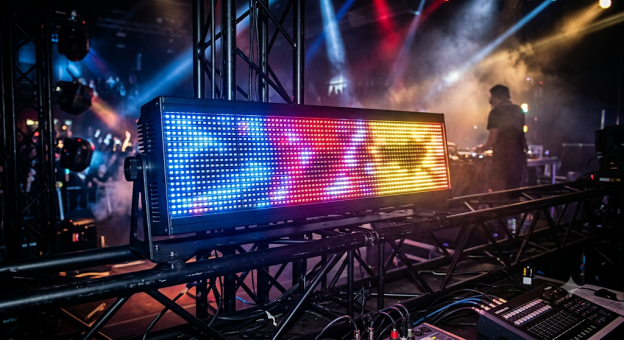
LED strobe lights produce rapid, high-intensity flashes using an array of individually addressable diodes rather than a single lamp source. That array structure is the core difference from a traditional strobe and the reason modern strobe led lights can do things older fixtures never could: split the panel into zones, chase color across segments, run pixel-mapped patterns synced to a lighting console, or hold at full brightness as a steady wash rather than only flashing.
The flash itself is controlled electronically — a driver circuit pulses the LED array at a set rate, typically adjustable from roughly 1 flash per second up to 25 or more, either manually via onboard controls, through sound-activation, or via DMX for cue-based control synced to the rest of a rig.
LED Strobes vs. Xenon Strobes: What Actually Changed
Before LED arrays took over, most professional strobes ran on xenon flash tubes — the same technology used in camera flashes, just scaled up. Xenon strobes produce an extremely bright, punchy flash, but they come with real operating limitations: the tube has a finite lamp life and needs periodic replacement, there’s a brief recharge delay between flashes at high output, and color requires physical gels rather than electronic mixing.
LED strobes trade a bit of that raw peak intensity for practical advantages that matter more on a working rig: rated LED lifespans in the 50,000-hour range with no bulb to replace, no recharge lag between flashes, full RGB or RGBW color mixing without gels, and the ability to run the same fixture as a continuous colored wash when you’re not actively strobing. For most stage, club, and touring applications, that flexibility is why LED has become the default choice, even where xenon still shows up for very high-output specialty rigs.
What the Pixel Count on a Spec Sheet Actually Means
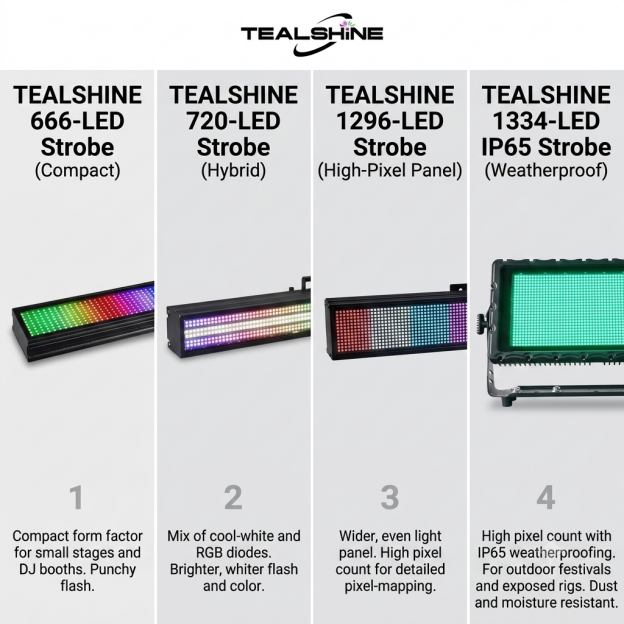
Strobe fixtures are usually named by their LED count — a “666,” a “720,” a “1296” — and that number tells you more than raw brightness. More individual diodes generally means a larger physical panel, smoother-looking output across the face of the fixture, and finer segmentation for pixel-mapped chase effects, since each diode or diode cluster can often be addressed as a separate pixel. Fewer diodes at higher individual wattage, by contrast, tends to concentrate output into a punchier, more compact flash better suited to smaller stages or DJ booths where physical space is limited.
Tealshine’s strobe range illustrates this spread directly. The 666-LED strobe sits at the compact end, suited to smaller stages and booth setups. Stepping up, the 720-LED model mixes cool-white and RGB diodes for a brighter, whiter flash alongside color. At the larger end, the 1296-LED strobe is built for bigger stages that need a wider, more even panel of light rather than a single concentrated burst. For outdoor or exposed installations, the IP65-rated 1334-LED strobe panel carries the same high pixel count with weatherproofing added for festivals, tented events, or any rig exposed to dust and moisture.
Blinder-Style Strobes: A Different Job Than a Panel
Not every strobe is built to flash a wide, even panel. Blinder fixtures use a small number of very high-output LED clusters — often described as “eyes” — arranged to hit the audience directly with a brief, disorienting burst rather than illuminate the stage itself. They’re a distinct tool from a pixel panel strobe: fewer, more powerful emission points instead of many smaller ones. Tealshine’s four-eye LED blinder is built specifically for this audience-facing role, mixing RGB, warm-white, and high-output white diodes across four clusters for that impact effect.
Moving Strobes: Adding Position to the Effect
A newer category on the market pairs a strobe head with a motorized pan-and-tilt base, letting the flash itself sweep across a stage or audience rather than staying fixed in one position. This adds a directional, moving element to what would otherwise be a static burst — useful for productions that want strobe timing synced with movement rather than a flat wall of flash. Tealshine’s range includes the IP65 Mini 1176 moving strobe and the smaller IP65 Mini 720 moving strobe, both combining RGB and white LED arrays with motorized movement in a weatherproof housing.
Key Specs to Check Before Buying
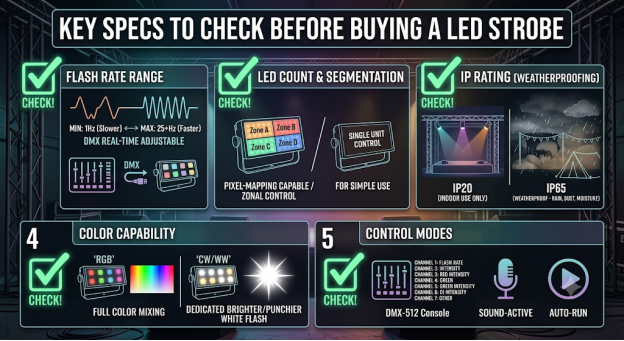
Flash rate range. Confirm both the minimum and maximum flash speed and whether it’s DMX-adjustable in real time during a show, rather than fixed to onboard presets only.
LED count and segmentation. Higher pixel counts support finer pixel-mapped chases; check whether the fixture is addressable in zones or only as a single unit if chase effects matter for your setup.
IP rating. IP20 fixtures are built for indoor use only. If the strobe will ever run outdoors, tented, or in a venue with fog/haze systems that add moisture to the air, confirm an IP65 rating instead.
Color capability. RGB and RGBW arrays support full color mixing; cool-white/warm-white (CW/WW) segments are built specifically for a brighter, punchier white flash that pure RGB mixing can’t fully replicate.
Control modes. Confirm DMX-512 support for console-cued control, plus onboard sound-active and auto-run modes for standalone use without a full lighting rig. Most DMX-controlled strobes expose a handful of channels rather than a single on/off toggle — typically one channel for flash speed, one for master dimming or strobe intensity, and separate channels for red, green, and blue (or white) intensity when color mixing is supported. Knowing the channel count in advance matters when patching the fixture into an existing console setup or a larger rig with dozens of addressed fixtures.
Power Draw and Rigging Considerations
Higher pixel-count panels don’t just cost more — they draw more current, which matters when planning power distribution across a touring rig or a venue’s existing circuits. A bank of several 1296-LED or 1334-LED panels running together can add up quickly compared to smaller 666-LED units, so it’s worth checking amperage draw per fixture against available circuits before finalizing a strobe wall or bank for a show, rather than discovering a shortfall on load-in day.
Physical mounting differs by format too. Flat panel strobes are generally lighter and easier to fly on truss in banks, while blinder-style fixtures with their heavier eye clusters and moving-head strobes with motorized bases need sturdier rigging points and clearance to pan and tilt without obstruction — a detail worth confirming against the venue’s rigging plot before a fixture ships.
A Safety Note Worth Building Into Any Strobe-Heavy Show
High-frequency strobing can trigger photosensitive seizures in a small percentage of the population, and event industry guidance generally recommends signage or a verbal announcement whenever strobe effects will run for an extended period, particularly in enclosed venues. This isn’t a reason to avoid strobes — it’s standard practice at concerts, clubs, and theatrical productions worldwide — but it’s worth building into a show’s pre-production checklist alongside fog and haze disclosures, rather than treating it as an afterthought.
Where LED Strobe Lights Get Used
- Concert and festival production — timed bursts on drops, hits, and big transitions across EDM, rock, and pop shows.
- Club and DJ setups — built into permanent rigs or DJ booth lighting for sound-activated bursts synced to the beat.
- Theatrical and haunted-attraction effects — used sparingly for jump-scare timing, lightning effects, or scene transitions.
- Corporate reveals and product launches — a single high-impact strobe moment on a product unveil or stage entrance.
- Photography and videography — freeze-motion effects for dance and action shoots where a continuous light source would blur movement.
Frequently Asked Questions
What’s a reasonable flash rate for a live event strobe?
Most professional shows run strobe effects well below maximum flash speed for short, timed bursts rather than sustained high-frequency flashing. Because rapid strobing can affect photosensitive individuals, it’s worth pairing any extended strobe segment with advance signage or an announcement rather than relying on flash rate alone to manage the risk.
Can an LED strobe be used as a regular wash light?
Yes — most LED strobe panels can hold at full brightness without flashing, functioning as a static colored or white wash. This dual capability is one of the practical advantages LED arrays have over older xenon strobes, which can only flash.
What’s the difference between a strobe panel and a blinder?
A strobe panel spreads many smaller LEDs across a wide, even face for general stage flash effects. A blinder concentrates output into a handful of very bright clusters aimed directly at the audience for a sharper, more disorienting burst — a different tool for a different effect.
Do LED strobes need a DMX controller to run pixel-mapped chases?
For basic flash effects, no — onboard sound-active and auto modes handle that standalone. Pixel-mapped chase patterns across segments of the panel, however, generally require DMX control from a lighting console to program and trigger those sequences.
Do strobe lights work well with fog or haze in the room?
Yes, and the two are often used together deliberately — haze in the air scatters the flash and makes the beam itself visible as a shaft of light rather than just a flat burst on flat surfaces, which is part of why touring productions frequently run haze machines alongside strobe effects rather than relying on strobes alone.
Final Thoughts
The right led strobe light for a job depends less on raw brightness than on matching pixel count, IP rating, and control mode to the venue and the effect you’re actually going for — a compact 666-LED unit for a small booth does a different job than a 1334-LED weatherproof panel built for a festival stage, even though both fall under the same product category.
Browse Tealshine’s full LED strobe lighting range to compare all nine models side by side, or get in touch about OEM/ODM options for custom pixel configurations and housing specifications.