Professional High Quality Stage Lighting Manufacturer



Table of Contents
Wrong stage lighting doesn’t just look bad — it actively works against the event. A wash fixture at close range in a DJ booth produces a blinding overexposed mess rather than an atmosphere. A beam fixture without haze in a dry corporate conference room shows up as a small bright dot on a wall instead of a dramatic shaft of light. An outdoor festival stage running indoor-rated IP20 fixtures through a rain shower trips breakers and kills the show.
The right lighting setup depends on the event type, not just the budget. This guide covers six common event formats — what each one demands from a lighting rig and exactly which fixture types cover those demands, with specific configurations rather than vague recommendations.
Quick Reference: Which Fixtures for Which Event
| Event Type | Primary Fixture | Supporting Fixtures | Key Spec to Check |
| Wedding Reception | Battery powered uplighting | Par can lights | Runtime, IP rating if outdoor |
| Concert / Live Music | Moving head beam | LED strobe lights | Haze compatibility, throw distance |
| DJ Night / Club | Moving head wash | Strobe lights, LED bar | Short-throw beam angle, fan noise |
| Theater Production | Par can (COB/zoom) | Moving head wash, LED wall wash | CRI, dimming smoothness |
| Corporate / Conference | Par can (standard wash) | Battery uplighting, LED wall wash | Fan noise, color temp accuracy |
| Outdoor Festival / Tent | IP65 par can + IP65 strobe | Battery powered uplights | IP65 rating, power distribution |
1. Wedding Reception
A wedding reception has three distinct lighting jobs happening simultaneously: ambient perimeter color that sets the room’s mood for guests, accent lighting on specific focal points (the head table, the cake, the arch), and enough general illumination to ensure photos from any angle don’t come out underexposed or color-cast.
What the Lighting Needs to Do
- Create consistent, photogenic color across all perimeter walls without hot spots behind the head table
- Accent the ceremony arch or altar with backlighting that frames the couple without washing out their faces
- Function without any taped cable runs across the floor — most venues prohibit this for safety reasons
- Run for 8+ hours from setup through end of reception without intervention
The Right Setup
The backbone of a wedding lighting rig is battery powered uplighting — cordless, IP-rated fixtures that sit on the floor against walls and columns, aimed upward, requiring no cable runs. For a typical 100–150 guest reception ballroom (roughly 160–240 feet of usable perimeter wall), 16–24 battery uplights spaced every 8–10 feet produces a continuous, even wash.
Color choice matters more than fixture count for wedding photography. Warm white in the 2700K–3000K range flatters skin tones and doesn’t introduce color casts across every photo taken against the backdrop. Saturated colors — deep reds, purples, electric blues — look striking to the eye but shift the color cast in every photo taken against that wall in a way that’s difficult to correct in editing.
For the ceremony arch specifically, 2–4 additional fixtures positioned behind and to the sides of the arch for backlighting, plus 2 more at the aisle entrance, complete the look without requiring separate wired fixtures in a space where cable management is most difficult.
Where a wired par can outperforms battery options: if the venue has easily accessible outlets near each wall section and the planner wants to maximize brightness and minimize fixture cost per unit, wired par can lights are a lower-upfront-cost alternative for fixed reception venues where load-in time isn’t a constraint.

2. Concert and Live Music
A concert rig has to do things a wedding rig never needs to: cut visible light shafts through haze over long distances, produce high-energy effect transitions timed to musical moments, and create a visual experience that reads clearly to the back of a large room. The fixture types that accomplish this are fundamentally different from anything a wedding or corporate event uses.
What the Lighting Needs to Do
- Produce visible aerial beam effects in haze above and across the crowd
- Create sharp, timed transitions — drops, chorus hits, builds — that sync to the music
- Provide even stage wash so performers are visible from any seat in the venue
- Add strobe effects for high-energy moments without flashing at hazardous frequencies
The Right Setup
The layered approach that professional touring rigs use: wash fixtures for stage coverage, beam fixtures for aerial effects, and strobes for impact moments.
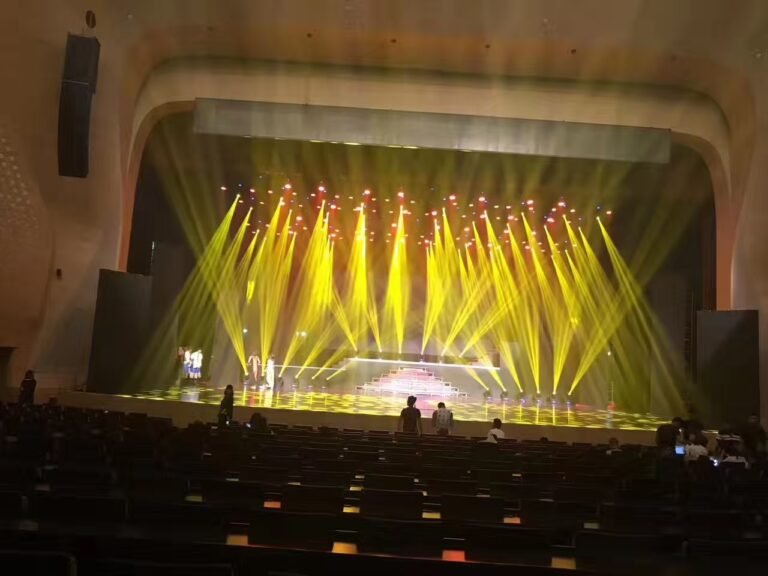
Moving head beam fixtures — typically 150W–200W for mid-size venues — mounted on front truss or flown positions provide the aerial shaft effects that define a concert visual. These fixtures only produce visible shafts when atmospheric haze is in the air; a haze machine is a necessary companion to a beam-heavy rig, not an optional upgrade.
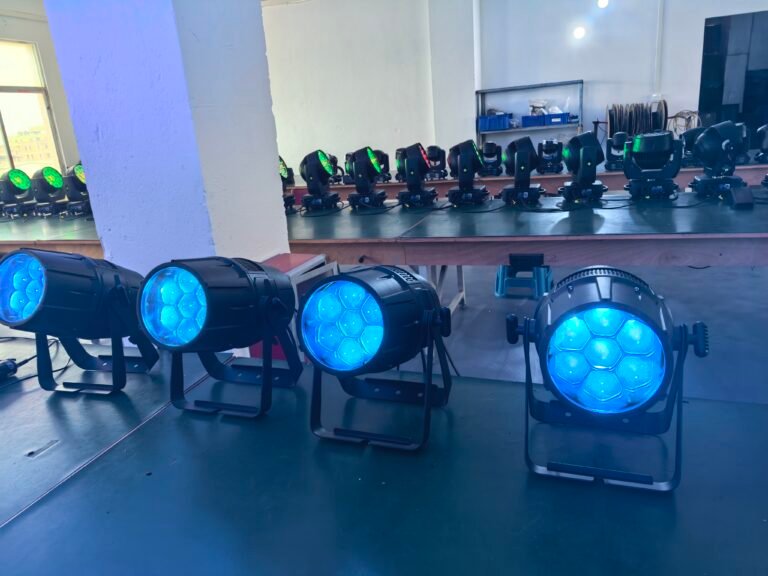
Behind the performers, wash moving heads cover the stage backdrop in even, movable color. A pair of 7×40W or 19×40W bee eye wash fixtures positioned high and behind the band provides full backdrop coverage that can change color and position during the show without the flat, static look of fixed par cans.
LED strobe panels positioned at stage level facing the audience create the blinder flash effect on chorus peaks and drops. The pixel count on the strobe matters here — a 1296-LED panel produces a wider, more even flash panel than a 666-LED unit, which reads better across a large crowd rather than a single concentrated burst.

3. DJ Night and Club Lighting
A club or DJ night lighting rig operates under constraints that a touring stage rig doesn’t face: close ceiling heights (often 2.5–4 meters), no dedicated lighting operator, fixtures running continuously for years rather than being loaded in and out, and guests standing close enough to hear the cooling fans on high-wattage fixtures.
What the Lighting Needs to Do
- Cover a DJ booth face and back wall at 2–3 meter throw distance with even wash
- Produce sound-reactive effects without a DMX console or lighting operator
- Run quietly enough that cooling fan noise isn’t audible to guests during quieter moments
- Function reliably for hundreds of consecutive nights without service issues
The Right Setup
At 2.5–3 meter ceiling height, beam angles of 40°–60° rather than concert-stage-standard 15°–25° produce usable coverage across a booth face without leaving hot spots. A 25° beam at 2.5 meters covers roughly 1.1 meters of wall — fine for a single accent point, but a full booth front needs three or four fixtures at that angle where a single 50°+ fixture handles the same span.
Wash moving heads — specifically compact 7×40W bee eye models — work well in club ceiling mounts because motorized zoom lets the operator adjust angle for different throw distances without swapping fixtures. Sound-active mode covers most routine nights without console programming; master/slave linking syncs multiple units together for symmetrical effect without patching DMX.
A strobe element — either a standalone strobe panel or a strobe bar at booth level — handles peak-moment flash effects on drops. At club scale, a 720-LED strobe with both RGB and cool-white channels produces a brighter, whiter flash than RGB alone at comparable fixture sizes.
For moving beam bar effects specific to DJ setups, the 12×40W wave bar format produces a pixel-chase sweep across its 12 lenses that reads differently from a single-head beam — 12 discrete shafts spanning a wide horizontal range as the bar tilts, rather than one concentrated shaft.
4. Theater Production
Theater lighting demands a precision that DJ or concert rigs don’t prioritize: accurate color rendering for skin tones and costumes under stage light, smooth dimming curves without visible stepping or flicker, and precise beam control that can hold a specific stage position cued to a script rather than chasing a beat.
What the Lighting Needs to Do
- Illuminate performers’ faces accurately enough that expressions read from the back of the house
- Color-render costumes and set pieces faithfully without introducing unexpected hue shifts
- Dim smoothly from full brightness to blackout without visible stepping at low levels
- Hold precise fixed positions for extended scenes without drift or motor noise
The Right Setup
COB par cans — chip-on-board fixtures that concentrate all LEDs into a single high-density array — produce a smoother, more even beam with fewer visible hot spots than multi-LED arrays, which is why they’re preferred for front light and downlight positions in theatrical work. A CRI rating of 90 or above ensures that the costume designer’s choices translate accurately under stage light rather than shifting hue under standard RGB fixtures.
Zoom par cans provide the beam angle flexibility that a fixed theater rig needs: narrowing to cover a specific downstage position precisely, or widening to wash a broader section of the stage without repositioning the fixture. A motorized zoom also means the same fixture set can be reprogrammed for different productions rather than requiring physical lens changes.
Moving head wash fixtures behind the performers handle the cyclorama and backdrop wash that par cans aren’t built for at the required coverage width. A bee eye wash zoom model positioned high above the stage provides even, edge-to-edge cyc coverage with motorized color change between scenes — dramatically faster than manually relamping a traditional cyclorama strip.
For productions requiring projected patterns — logos, architectural shapes, or text on a backdrop — a spot moving head with a gobo wheel handles this. Tealshine’s 200W Mini LED Spot Moving Head Light covers this specific requirement within the existing range.
5. Corporate Event and Conference
Corporate event lighting has a different objective from every other event type: it needs to disappear when the presentation is the focus, and complement the brand palette when the room is in reception or networking mode. The worst corporate lighting setup is one guests are aware of — either because it’s too dramatic, too colorful, or because cooling fans are audible during a keynote address.
What the Lighting Needs to Do
- Provide clean, neutral front light that renders speaker skin tones accurately for camera and live audience
- Set a consistent brand color palette on the backdrop and perimeter walls during branded moments
- Operate silently enough that no ambient equipment noise is audible from the main seating area
- Set up and strike efficiently within often tight venue access windows
The Right Setup
A standard corporate setup uses two distinct fixture layers: front wash for speaker visibility, and ambient uplighting for brand color and atmosphere.
For speaker front wash, high-CRI par cans (CRI 90+) at 3200K–4000K color temperature provide accurate skin tone rendering for both live viewing and camera capture. These are typically wired fixtures positioned at FOH (front of house) on stands or a front truss, aimed at the stage from a 45° downward angle to eliminate shadow on the speaker’s face.
Battery powered uplighting handles the brand color layer on perimeter walls, columns, and stage backdrop. Because most conference venues are in hotels or convention centers with strict cable management rules, battery fixtures remove the floor-tape conversation with venue operations entirely. Setting 16–20 units in a medium ballroom to a brand-matched color takes less than 30 minutes for one person.
Fan noise is a genuine concern in conference environments where ambient noise competes with a speaker mic. Request noise ratings from the manufacturer for any fixture that will be operating within 5 meters of a speaker microphone or a lectern — high-wattage fixtures with aggressive cooling fans can be audible in quiet moments.
6. Outdoor Festival and Tented Event
Outdoor and tented event lighting faces a constraint every other event type ignores: weather. A fixture rated IP20 (standard indoor specification) is not sealed against moisture — running one through light rain, heavy condensation, or a morning dew before a day event can cause electrical failure. IP rating is not optional for outdoor use, and getting it wrong is not a lesson that fixes itself on the night.
What the Lighting Needs to Do
- Survive weather exposure — rain, dew, humidity — without electrical failure or premature deterioration
- Function without reliable outlet access in tented or open-air positions
- Compete with ambient light at dusk before full darkness, when stage lighting starts to read clearly
- Cover large open spaces that indoor room dimensions don’t prepare for
The Right Setup
Every outdoor fixture needs an IP65 rating at minimum — this covers dust-tight sealing and protection against water jets from any direction, appropriate for rain and heavy dew. IP65 applies to the fixture housing, not necessarily to any connectors or cable entry points, so confirm that cable glands and power connections are also weatherproofed rather than assuming the housing rating covers the full system.
For a festival stage with haze, IP65-rated beam fixtures combined with a hazer or fog machine produce the aerial shaft effects that make an outdoor night show visually compelling. The outdoor version of the lighting challenge is throw distance: open-air stages often have longer distances between fixture position and the performance area than indoor venues, which favors higher-wattage fixtures with tight beam angles over close-range wash models.
For a tented event — a wedding marquee, a private garden reception, a branded outdoor activation — the scale of the challenge is smaller but the IP requirement remains the same. Battery powered uplighting with IP65 or IP54 rating covers tented perimeter wash without requiring cable runs through a space where poles, tent walls, and flooring make routing difficult.
Power distribution is the operational challenge most outdoor events underestimate. Confirm generator capacity or site power circuit ratings before finalizing fixture counts. A bank of ten 200W beam fixtures draws 2,000W continuously — verify that available power infrastructure supports the full rig at operating brightness before the event, not during load-in.
For large outdoor stages where the floor surface itself needs illumination — front-of-stage wash pointing down at performers from a low-hung position — Tealshine’s 40×20W Outdoor Stage Panel Floorlight is purpose-built for this outdoor floor-wash role, rated for outdoor exposure at 800W total output across the 40-LED array.
The Most Common Lighting Mistakes Across All Six Event Types
| Event Type | Most Common Mistake | Why It Matters |
| Wedding | Oversaturated color | Shifts skin tones in every photo against that wall |
| Concert | Beam fixtures without haze | No aerial effect — just a bright dot on the surface behind |
| DJ Night | Wrong beam angle for ceiling height | Narrow beam at 2.5m = hot spot, not coverage |
| Theater | Low-CRI fixtures for front light | Costumes and skin tones shift under stage light |
| Corporate | High fan noise fixtures near speakers | Audible during quiet keynote moments |
| Outdoor | IP20 fixtures in exposed positions | Electrical failure from moisture — real risk, not theoretical |
Frequently Asked Questions
Can I use the same fixtures across multiple event types?
Some fixture types are genuinely multi-purpose — par cans with zoom functions work across wedding, corporate, and theater applications. Beam moving heads are more event-specific: they’re built for shows with haze and need that atmospheric content to produce their primary visual effect. Matching fixture type to event type before buying avoids owning equipment that technically works but underperforms in practice.
What is the minimum rig for a professional-looking result at each event type?
Wedding: 12–16 battery uplights for a medium room. Concert: 4 beam moving heads + 2 strobes. DJ night: 2 wash moving heads + 1 strobe. Theater: 6–8 par cans (front + side) + 2 wash moving heads for backdrop. Corporate: 8 high-CRI par cans + 12 battery uplights. Outdoor tent: 10–16 IP65 battery uplights.
Do I need DMX control for all these setups?
Not for every event. Battery uplights, par cans, and smaller strobe setups can run in sound-active or standalone modes without a console. Theatrical productions and complex concert shows generally need cued DMX control for precise, repeatable scene changes. A mid-range mobile DJ setup runs effectively in master/slave mode with no console at all.
How important is IP rating for an outdoor tented event vs. a fully open-air festival stage?
Both need weather protection, but the exposure level differs. A fully open-air festival stage has no overhead protection — rain falls directly on fixtures, and IP65 is the minimum. A tented event has some overhead cover but still faces heavy humidity, dew, and splash from rain hitting the tent structure. IP54 (splash-resistant) is the minimum for a tented environment; IP65 is safer if the tent has significant open sides or if the event runs overnight into morning dew conditions.
Final Thoughts
The single most important variable in stage lighting isn’t budget or wattage — it’s matching the fixture type to the event’s actual requirements. A beam fixture at a corporate conference wastes its capabilities and creates noise problems. A standard wash par can at an outdoor festival that gets wet will fail. Getting the fixture type right for the event is the decision that determines whether a rig performs or disappoints.
Tealshine manufactures stage lighting across all six categories covered in this guide. Browse the full product range to find the right fixture type for your specific event, or get in touch about OEM/ODM options for custom specifications, bulk orders, or branded inventory builds.