Professional High Quality Stage Lighting Manufacturer


Table of Contents
A wedding DJ and a touring lighting designer need different things from a moving head light. A touring rig has a crew, a truss, and time to program cues. A mobile DJ usually sets up alone, in under an hour, with no separate lighting operator. That gap is what this guide covers — which dj moving head lights actually work for that reality, and how to run them without a full production setup.
For a full breakdown of how moving heads work, see our complete guide to moving head lights.
What Makes a Moving Head DJ-Friendly?
A DJ-friendly moving head sets up fast, runs quietly, and works without a lighting console. Four things decide whether a fixture fits that job:
- Weight and size — a solo DJ carries and mounts every fixture alone, so a lighter housing matters more than it does on a crewed rig.
- Standalone control — most mobile DJs don’t run a DMX console, so onboard sound-active or auto-run modes need to work well without one.
- Fan noise — indoor venues sit close to guests. A loud cooling fan is noticeable in a quiet ceremony or a dinner set in a way it never is at a festival.
- Setup time — a fixture that clamps to a lightweight stand and powers on in seconds fits a one-hour load-in far better than a rig built for truss mounting.
Beam or Wash for a DJ Setup?
Most DJ setups benefit more from wash coverage than sharp beam effects. A wash fills the booth and dance floor with color guests can actually see on camera; a beam reads best in haze, which most DJ venues don’t run. That said, pairing one or two beam fixtures with a wash gives a setup both a steady base look and sharper accent moments for drops.
Compact Options for Small Setups
For a solo DJ or a small booth, the priority is light weight and simple standalone operation over raw output.
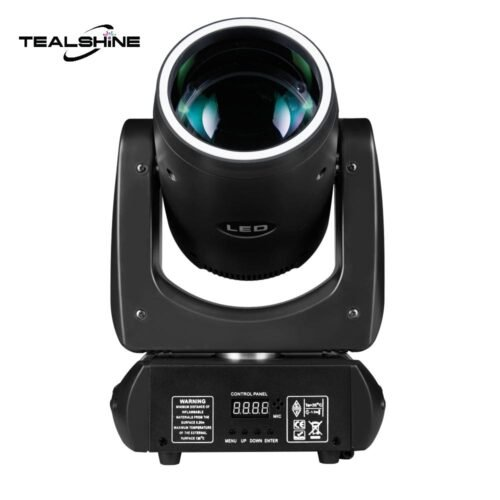
The 120W LED moving head beam is Tealshine’s lightest beam fixture, sized for a single stand rather than truss mounting. Paired with the 7×40W bee eye wash zoom, a two-fixture setup covers both a steady wash and an accent beam without needing a full rig.
Options for Bigger DJ Setups and Club Installs
A club installation or a larger event with more open floor space can support higher-output fixtures without the portability tradeoff a solo mobile DJ deals with. The 61×25W Aura wash covers more floor area with a smoother pixel-mappable wash, a better fit for a fixed club rig than a fixture swapped in and out of a car trunk every weekend.
Running Moving Heads Without a Full DMX Rig
Sound-active mode lets a fixture react to music automatically, without any DMX programming. A built-in microphone triggers color changes and movement on the beat, which is why it’s the default way most mobile DJs run moving heads.
Master/slave linking connects multiple fixtures so they mirror each other’s movement and color without a console. One fixture — the master — sends its settings to the rest over a cable, so a two- or three-fixture setup moves in sync without any programming at all.
Buying Moving Heads in Pairs
Most DJ setups buy fixtures in twos rather than as a single unit. Symmetrical placement — one fixture on each side of a booth or stage — reads better to a crowd than a single off-center light, and it gives sound-active or master/slave setups a mirrored look without any extra programming.
Frequently Asked Questions
Do I need a DMX controller to run moving heads as a DJ?
No. Sound-active and master/slave modes cover most mobile DJ setups without a console. DMX becomes useful once a setup grows beyond a few fixtures or needs cued, choreographed movement.
How many moving heads does a small DJ setup need?
Two is the common starting point — one on each side of the booth or stage — enough for symmetrical coverage without overcomplicating setup or teardown.
Are moving head lights loud?
Cooling fan noise varies by model and output. Higher-wattage fixtures generally run louder fans; for quiet indoor settings like ceremonies or dinner sets, checking a fixture’s noise rating before buying is worth the extra step.
Can moving heads run wirelessly in a mobile setup?
Power still requires a cable, but control doesn’t have to — fixtures with built-in wireless DMX can be grouped and controlled from an app or transmitter without running a signal cable between them, which simplifies a mobile load-in.
Final Thoughts
The right dj moving head lights setup comes down to matching the fixture to how a mobile DJ actually works: fast setup, standalone control, and manageable weight — not the highest wattage on the spec sheet.
Browse Tealshine’s full moving head lighting range to compare all models side by side.