Professional High Quality Stage Lighting Manufacturer


Table of Contents
Search “rgb led strobe light kit” and most results aren’t kits at all — they’re single fixtures, sometimes sold in a pair with a carry case, labeled “kit” for search visibility. That distinction matters the moment you need multiple units to chase or sync together, because a box labeled “kit” doesn’t guarantee the units inside share the same firmware, DMX profile, or flash timing.
Here’s the short version: if you need synced multi-unit effects, buy from a single product line and confirm the DMX personality matches across units before ordering. If you just need one or two standalone fixtures, the “kit” label barely matters. The rest of this guide covers the specs that actually decide whether a strobe setup performs the way the listing implies.
What a “Kit” Actually Means
A genuine kit is a matched set — same fixture, same firmware revision, same DMX channel layout — sold together specifically so multiple units run in sync out of the box. Most listings using “kit” in the title are individual fixtures bundled with a case or clamp, not a verified matched set.
The practical risk: ordering three “kits” from three separate listings, even of the same advertised model, can land you with three different firmware revisions if the manufacturer updated the fixture between production runs. Different firmware can mean different DMX channel counts for the same nominal model — a real problem if you’re patching them into one universe expecting identical behavior.
Flash Rate: The Spec Most Listings Overstate
Check whether the advertised maximum flash rate is achievable at full RGB brightness, not just in white-only mode. Many spec sheets list a peak flash rate tested with a subset of diodes firing — often the white channel alone — because full-color flashing at maximum speed draws more current and generates more heat than a single-channel white flash.
Ask the manufacturer directly whether the published flash rate applies across full RGB output. If a listing can’t answer that clearly, treat the number as a best-case figure rather than a guaranteed spec, and confirm before ordering in volume.
Duty Cycle: The Spec Between Flash Rate and Overheating
Duty cycle determines how long a fixture can strobe at maximum rate before internal temperature forces it to throttle output or shut down. A fixture rated for intermittent use might handle short bursts fine but drop brightness noticeably during a 20-minute continuous strobe segment at a festival set.
Ask specifically whether the fixture is rated for continuous operation at full output or only intermittent bursts. This detail rarely appears on a spec sheet unless you ask, and it’s the difference between a fixture that holds steady through a long strobe-heavy set and one that visibly dims halfway through it.
Color Depth and Dimming Resolution
An 8-bit DMX channel gives 256 brightness steps per color; a 16-bit channel (using two combined DMX channels) gives 65,536 steps. The difference shows up specifically at low brightness — 8-bit dimming can produce visible stepping or banding when a fixture fades slowly through a dim color, while 16-bit holds a smooth gradient.
For fast strobe effects, 8-bit is usually sufficient since the eye isn’t tracking gradual fades. For a fixture doing double duty as a slow color wash between strobe cues — which most LED strobes can do — 16-bit dimming is worth the extra DMX channel if the console supports it.
DMX Compatibility Across a Multi-Unit Setup
Three checks prevent the most common multi-unit sync problems:
- Confirm all units run the same firmware version — ask the supplier directly rather than assuming units from one order match units from a previous order.
- Confirm the DMX channel mode is identical — some fixtures offer a 4-channel “basic” mode and an 8-channel “full control” mode; mixing modes across units breaks synchronized programming.
- Request the DMX chart before ordering — a one-page document showing exactly what each channel controls, so your programmer isn’t guessing after the units arrive.
A concrete version of this problem: a rental company orders eight strobes in one shipment, then orders four more identical units three months later to expand the set. If the manufacturer updated firmware between those two production runs, channel 5 might control strobe speed on the original eight units and control a color macro preset on the newer four — and the mismatch won’t show up until a programmer patches all twelve into one DMX universe and the newer units behave unpredictably on cue.
IP Rating: What the Number Doesn’t Tell You
An IP65 rating covers dust and low-pressure water jets — it does not mean submersible, and it does not guarantee performance in extended heavy rain without additional shelter. For outdoor events longer than a few hours, pair an IP65-rated strobe with basic overhead cover rather than relying on the rating alone as full weather insurance.
Procurement Risk: What to Verify Before Ordering in Bulk
- Request a sample unit before a bulk order — confirm flash rate, color accuracy, and DMX response match the spec sheet on the actual hardware, not just the listing.
- Confirm lead time in writing — firmware and component revisions change between production runs; locking a delivery window reduces the chance of receiving mismatched units across a large order.
- Ask about factory-matched sets for orders over a handful of units — a manufacturer that can guarantee identical firmware across a production batch removes the DMX mismatch risk entirely.
Here This Matters Most
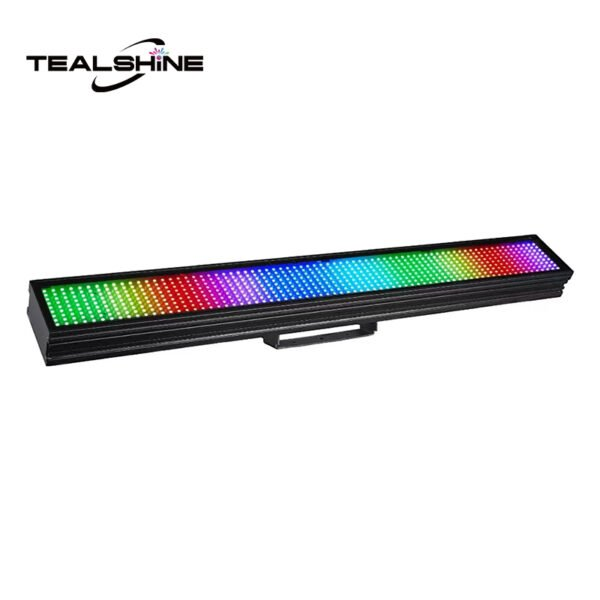
- Touring and festival rigs — multiple strobe banks running identical chase patterns depend entirely on matched DMX behavior across every unit.
- Club installs — a fixed installation running for years benefits from ordering spares from the same production batch as the original install, to keep replacements behaving identically.
- Rental inventory — mismatched firmware across a rental company’s stock creates support headaches on-site, since crews can’t assume every unit in the case behaves the same way.
For the full breakdown of pixel counts, IP ratings, and blinder vs. panel formats across our range, see our complete guide to LED strobe lights.
Frequently Asked Questions
Does “RGB” always mean full color mixing on a strobe fixture?
Not always. Some fixtures labeled RGB use fixed color presets rather than full 0–255 mixing per channel. Confirm the fixture supports independent RGB channel control via DMX if smooth custom colors matter for your show.
Can I mix fixtures from different manufacturers in one synced kit?
Technically yes, if every fixture supports standard DMX-512 and you manually match channel modes. In practice, matching timing and color response across brands is harder than sourcing matched units from one manufacturer.
What happens if I order strobes with mismatched firmware?
Chase and sync effects programmed for one unit’s channel layout may not translate correctly to another. Symptoms include one fixture flashing out of time with the rest, or a channel controlling the wrong parameter on part of the set.
Final Thoughts
A rgb led strobe light kit is only as reliable as the match between its units. Verify firmware consistency, DMX channel mode, and real-world flash rate at full color before ordering — especially in volume — rather than trusting the word “kit” on a listing to guarantee synchronized behavior.
Browse Tealshine’s LED strobe lighting range, or ask about factory-matched multi-unit sets through OEM/ODM for orders where synchronized behavior across every unit is non-negotiable.