Professional High Quality Stage Lighting Manufacturer



Table of Contents
Most buyers who search “beam vs wash moving head lights” already know they’re looking at two different things — they just can’t find a straight answer on exactly what makes them different and which one they actually need. The confusion usually comes from the fact that both are motorized, both look similar in a catalog photo, and both get called moving head light fixtures in every listing. The difference isn’t cosmetic. It’s optical — and getting it wrong means buying a fixture that works perfectly but does entirely the wrong job for your show.
This guide explains what each type does at the physics level, shows where each one excels and where each one fails, and gives you a clear decision framework — not just a table of specs, but a real explanation of why the numbers translate into what you actually see on stage.
The Core Physics: Why These Three Types Look Completely Different
All three types use LED sources and motorized pan/tilt. The difference is entirely in what happens between the LED and the air in front of the fixture — the optics.
Beam: Collimation Is Everything
A beam moving head light is built around one goal: keeping light rays as parallel as possible after they leave the source. This property — collimation — is what produces a tight, visible shaft of light rather than a spread-out wash. Inside a beam fixture, a small-diameter primary lens sits close to a single concentrated LED source (or a tightly clustered array), and its shape is calculated to redirect diverging rays from the source back into a parallel bundle.
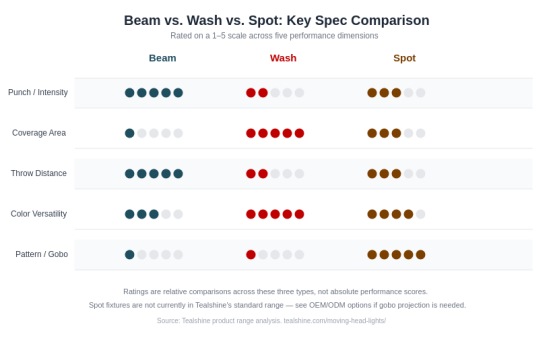
The result is a beam angle typically between 1.5° and 5°. At 10 meters, a 3° beam covers a circle roughly 52cm across. At 20 meters, that same beam covers about 1 meter. It holds its shape. Compare that to a wash fixture at the same distances — by 20 meters, the wash has spread to 8 or 10 meters wide and has lost most of its visible intensity per square meter.
The trade-off is that the beam is only visible as a shaft in the air when there are particles in the atmosphere to scatter the light — haze, fog, or smoke. In a completely dry room, a beam fixture mostly produces a bright dot on whatever surface it hits, with no visible shaft between the fixture and the surface. This is the single most important thing beam buyers don’t understand before they order.
Wash: Even Coverage Over a Wide Area
A wash moving head uses the opposite optical approach. Instead of concentrating light into a parallel shaft, it deliberately spreads output across a wide area using a multi-lens array — often a “bee eye” configuration, where dozens of small individual lenses each collect a portion of the total LED output and aim it slightly outward. The combined result is a wide, soft-edged, even field of light rather than a shaft.
Wash fixtures typically run beam angles of 15°–45°, and many include a motorized zoom that lets the operator adjust that angle in real time — narrowing to concentrate output at long throw distances, or widening to cover more area at close range. A well-specified wash zoom fixture can function as both a tight accent light and a broad coverage wash depending on the DMX zoom setting.
The trade-off for wash is the opposite of beam: wash output looks soft and even, which is exactly what you want for backdrop lighting and even stage coverage — but it reads as flat rather than punchy in a show environment. A wash fixture doesn’t produce visible aerial shafts in haze, and it can’t throw tight concentrated effects over long distances the way a beam can.
Spot: The Third Lens — the Gobo
A spot moving head adds a layer of optical complexity that neither beam nor wash fixtures have: a gobo wheel. A gobo — short for “goes before optics” — is a small metal or glass disc with a pattern cut or etched into it, placed in the beam path to project that pattern onto a surface. The fixture’s output passes through the gobo’s cutout shapes before reaching the lens, which then focuses and scales the projected image onto a wall, floor, or screen.
A spot fixture is essentially a beam fixture with a projection slide system built in. It needs a tight, collimated source (like a beam fixture) to project a sharp, readable pattern — a wash fixture’s spread output would produce a blurry, unreadable projection. That’s why spot and beam fixtures share a concentrated single-source design, while wash fixtures don’t.
Most spot fixtures also include a color wheel (for saturated colors via physical dichroic filters, separate from LED mixing), a gobo rotation motor, a prism effect, and a focus motor for sharpening or softening the projected image. This makes spot fixtures the most mechanically complex of the three types — and the most expensive to service when mechanical components wear.
The Visual Comparison: What Each Type Actually Looks Like in Use
Where Each Type Excels and Where It Fails
Beam: Best At, Worst At
- Best at: aerial effects that cut through haze, long-distance throw where a wash would lose intensity, geometric patterns in the air above a crowd, sharp accent effects on a specific object.
- Worst at: even stage coverage (leaves dark spots between narrow shafts), close-range use in small venues where a 3° beam hits a tiny footprint a few feet away, any environment without haze where the shaft itself is invisible.
Wash: Best At, Worst At
- Best at: backdrop and cyclorama coverage, even stage wash that moves with performers, color fill across a wall or structure, close-range DJ booth and club coverage where a beam would be overconcentrated.
- Worst at: aerial effects visible in the air, long throws where output intensity drops significantly, punchy effects that read against high ambient light.
Spot: Best At, Worst At
- Best at: logo projection, architectural pattern work, sharp focused pool of light on a performer, geometric pattern overlay across a backdrop, effects that require color and pattern simultaneously from one fixture.
- Worst at: wide area coverage (same issue as beam), and any application where mechanical complexity is a maintenance concern — spot fixtures have more moving parts than beam or wash units.
The Haze Variable: Why Context Changes Everything
This point deserves its own section because it changes the beam vs. wash decision completely in certain environments.
In a haze-filled room — a club with a running hazer, a festival stage with atmospheric effects, a theatrical production with controlled fog — a beam fixture’s narrow shaft becomes visible as a physical column of light cutting through the air. That’s the look most people picture when they think of a beam effect: a sharp, glowing shaft sweeping the crowd.
In a dry room with no atmospheric content — a corporate event ballroom, a church, a hotel conference suite — the same beam fixture produces no visible shaft at all. The beam travels invisibly from the fixture to whatever surface it hits, producing a small bright dot. There’s no aerial effect, no sweep, no visual drama. The fixture works exactly as designed — but the design assumes atmospheric content in the air.
A wash fixture, by contrast, reads without any atmospheric content. The wide output reaches the surface and produces color coverage there — wall, backdrop, floor — whether or not there’s haze in the air. Wash fixtures are inherently more versatile across dry environments for this reason.
The practical rule: if you know the venue or event will always have controlled haze or fog, beam fixtures are the right tool for aerial effects. If the environment is dry and unpredictable, a wash fixture gives you a reliable visual result across all conditions — and a beam fixture in the same dry room is a significant underperformance relative to its spec.
Mixed Rigs: Why Most Productions Use All Three
Professional touring rigs and permanent venue installs rarely commit to one fixture type. They’re mixed specifically because each type covers a gap the others can’t fill:
- Wash fixtures handle the base layer — even color coverage across the stage, backdrop color, and fill light for performers.
- Beam fixtures handle the aerial effect layer — the visible shafts sweeping above the crowd, the geometric patterns in the haze, the dramatic transitions between show segments.
- Spot fixtures handle the precision layer — projected logos, pattern overlays, focused followspot-style pools on specific performers.
A rig with only beams looks dramatic but has no even coverage. A rig with only washes looks even and professional but lacks aerial punch. Most entry-level production rigs start with a 2:1 or 3:1 wash-to-beam ratio as a base, then add spot capability when pattern projection becomes a specific requirement for a show.
Tealshine’s Current Range: Beam and Wash, No Standard Spot
Tealshine’s current moving head lights range covers beam and wash types across eight models. The beam lineup runs from the 120W LED beam for portable DJ setups up to the 200W module beam for larger stages. The wash range includes the 7×40W bee eye wash zoom for compact setups and the 19×40W bee eye wash zoom for full venue coverage — both with motorized zoom for real-time beam angle adjustment.
Spot fixtures with gobo wheels are not in the standard range. If a project specifically requires gobo projection — logo work, pattern overlays, or theatrical shape effects — that’s an OEM/ODM specification that Tealshine can build against rather than something the standard lineup covers. It’s worth flagging that need directly rather than trying to approximate it with a beam fixture, which won’t produce usable gobo projection without the wheel mechanism.
Common Buying Mistakes for Each Type
Beam Mistakes
- Buying beam for a dry venue without planning haze. The fixture will technically work but produce no visible aerial effects — the primary reason to buy a beam fixture in the first place.
- Choosing beam for close-range booth use. A 3° beam at 2 meters covers a 10cm footprint. That’s a dot, not a lighting effect. Wash is the right fixture for short-throw club and booth applications.
- Comparing beam fixtures only on wattage. Lens quality and collimation efficiency determine how punchy a beam reads at distance, not total LED wattage alone. Two 150W fixtures from different manufacturers can look completely different in the air because of differences in optic design.
Wash Mistakes
- Expecting aerial beam effects from a wash fixture. Even in a hazy room, a wash fixture produces a diffuse glow rather than distinct visible shafts. If aerial shaft effects are the goal, the fixture type is wrong regardless of the environment.
- Underspecifying output for large stages. A wash fixture’s output spreads proportionally with distance — the same fixture that covers a 3-meter booth wall at 2 meters will cover only a fraction of a 10-meter stage backdrop at 6 meters with noticeably less intensity. Output drops off faster with distance for wash than for beam.
Spot Mistakes
- Assuming a beam fixture can project gobos. A beam fixture without a gobo wheel cannot project patterns — the wheel mechanism is a separate component that beam fixtures don’t include. This is the most common category confusion when buyers see the word “spot” used loosely in listings.
- Underestimating maintenance requirements. Gobo wheels, color wheels, and focus motors are mechanical components that wear and need service. Spot fixtures have more service requirements over their lifetime than beam or wash units.
Quick Decision Framework
| Your situation | Right choice |
| Venue has or will have haze, needs aerial shaft effects | Beam |
| Need even backdrop or stage color that can move | Wash |
| Short throw distance (under 3m), club or booth | Wash |
| Need to project logos, patterns, or shapes | Spot (OEM/ODM for Tealshine) |
| Mixed venue — some aerial effect, some coverage needed | Both beam + wash (separate fixtures) |
| Large venue, maximum coverage area | Wash with high LED count (19×40W or larger) |
| Mobile DJ setup, portability priority | 120W or 150W beam (light, manageable) |
Frequently Asked Questions
Can a beam moving head also function as a wash?
No — the optics are fundamentally different. A beam fixture’s narrow collimated lens produces a tight shaft. Widening the output enough to function as a wash would require a completely different lens system. Beam and wash are separate tools built for separate jobs, not adjustable variants of the same fixture.
What does “zoom” mean on a wash moving head?
A motorized zoom adjusts the beam angle in real time via a DMX channel — typically from a narrower angle (around 5°–10°) for tighter, more concentrated output at long throw distances, to a wider angle (35°–45° or more) for broad area coverage at shorter distances. Zoom doesn’t change the fundamental output type — a wash with zoom is still a wash, not a beam.
Do I need haze for a beam moving head to work?
Not technically — the fixture works without haze and will produce a bright dot on whatever surface it hits. But the aerial shaft effect that makes beam fixtures visually distinctive requires particles in the air to scatter and make the beam itself visible. Without haze, fog, or smoke, there’s no visible shaft — just a bright spot on a surface, which a wash fixture could produce more usefully at most distances.
How is a spot moving head different from a beam moving head?
Both produce a concentrated, collimated output. The spot fixture adds a gobo wheel — a mechanical disc with patterns that the beam passes through before exiting the lens, projecting the pattern onto a surface. A beam fixture without a gobo wheel cannot project patterns. The two types share a similar source design but serve different applications: beam for aerial effects, spot for projected imagery.
Can wash and beam moving heads be run on the same DMX network?
Yes. Both types use standard DMX-512 protocol. They’ll have different channel maps and different parameter sets — a beam fixture won’t have a zoom channel, for example, while a wash zoom fixture will — but they patch into the same DMX universe and can be controlled from the same console or controller simultaneously.
What’s the difference between a gobo and a prism effect?
A gobo is a physical disc with a pattern that projects an image. A prism is a glass optical element that splits a single beam into multiple beams radiating outward — producing a fan of light rather than a projected pattern. Spot fixtures often include both; beam fixtures may include a prism but not a gobo wheel; wash fixtures typically include neither.
Final Thoughts
The difference between beam, wash, and spot moving head lights is optical, not cosmetic. Beam concentrates and collimates. Wash spreads and covers. Spot collimates and projects through a pattern. Each one does its specific job well and fails at the other two jobs.
The mistake to avoid is buying the fixture type that looks most impressive in a specification sheet and then expecting it to cover all three roles on a real show. A beam in a dry room without haze is a wasted purchase. A wash at 20 meters trying to produce punchy aerial effects will disappoint. Match the fixture type to the specific visual result you need and the environment you’re working in — that decision matters more than any other spec on the sheet.
Browse Tealshine’s moving head lighting range to compare beam and wash options across all current models, or get in touch about OEM/ODM options if spot fixtures with gobo capability are a specific requirement.