Professional High Quality Stage Lighting Manufacturer


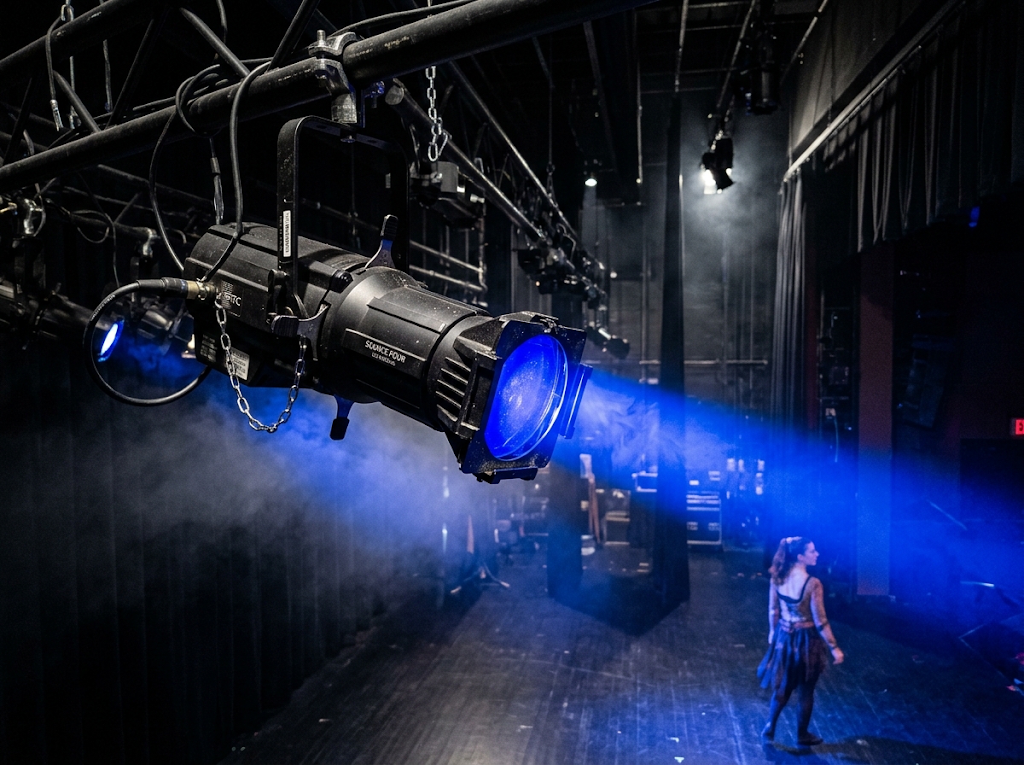
Table of Contents
Stage light gels are colored filters used to change the appearance of light on a stage. They can create warm or cool tones, add saturated colors, correct color differences between light sources, and help establish the atmosphere of a theatrical production or concert.
However, choosing the right stage light gels involves more than picking a color from a swatch book. The light source, filter transmission, fixture design, stage materials, and desired visual effect all influence the result. Traditional stage fixtures often use physical filters, while many modern LED stage lights generate colors electronically through built-in color-mixing systems.
This guide explains how theatrical lighting gels work, which colors are useful for different performances, how to combine colors effectively, and what to consider before using filters with stage lighting equipment.
What Are Stage Light Gels?
Stage light gels are transparent or translucent filters placed in a compatible lighting fixture’s optical path. A colored gel selectively transmits parts of the light spectrum while absorbing other wavelengths. The light that passes through the filter appears colored when it reaches the stage.
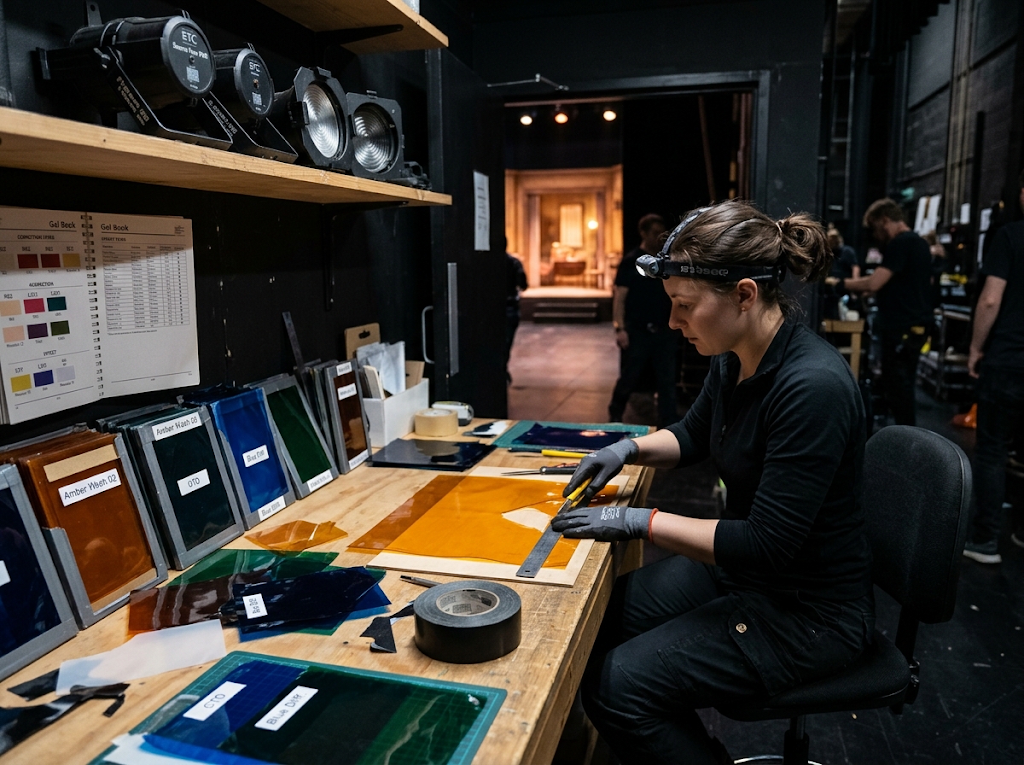
Although the word “gel” is still widely used in theatrical lighting, modern filters are generally made from engineered plastic film rather than gelatin. Depending on the product, filters may be designed for color effects, color-temperature correction, tint correction, or diffusion.
For example, an amber filter can warm a light beam, while a blue filter can introduce a cooler appearance. A diffusion filter can soften the beam or reduce the visibility of sharp edges. These different filter types serve different purposes, so it is important to identify the intended effect before choosing a product.
Physical gels are particularly associated with conventional theatrical fixtures that accept external filter frames. Some LED fixtures can also use approved external filters, but many full-color LED stage lights create colors internally without requiring a separate sheet of colored material.
Why Use Theatrical Lighting Gels?
Theatrical lighting gels give lighting designers a practical way to modify the color and quality of light. Their value depends on the fixture and production requirements.
Create a Specific Stage Atmosphere
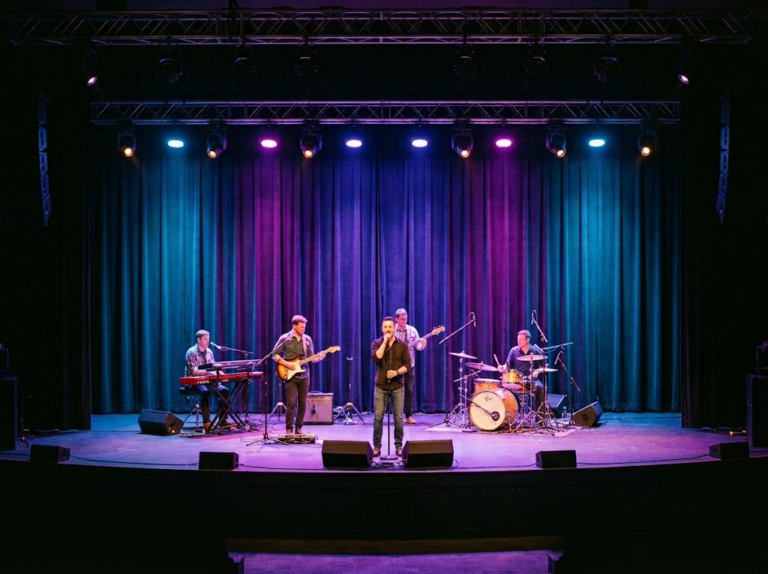
Colored light can help suggest different environments and emotional tones. Pale blue may support a cool night scene, amber can create a warm interior appearance, and deeper colors can establish a more stylized concert background.
Color alone does not determine how an audience interprets a scene. Brightness, direction, timing, movement, scenery, costumes, and surrounding colors all contribute to the final effect.
Correct the Color of a Light Source
Correction filters can adjust the appearance of a light source when a production needs to match different fixtures or camera requirements. CTO filters are commonly used to warm daylight-balanced light, while CTB filters can cool a warmer source. Green and magenta correction filters may help address unwanted tint differences.
The correct filter depends on the source spectrum and the intended reference. A filter cannot create wavelengths that the original light source does not emit, so the same filter may produce different results on different fixtures.
Modify Beam Quality and Intensity
Not every lighting filter is designed to add color. Diffusion materials can soften the appearance of a beam or help blend light, while neutral-density filters reduce output with minimal intended color change.
These materials should not be treated as interchangeable. Always check the filter manufacturer’s product information and confirm that the material is suitable for the fixture’s optical and thermal conditions.
Which Stage Light Gel Colors Should You Choose?
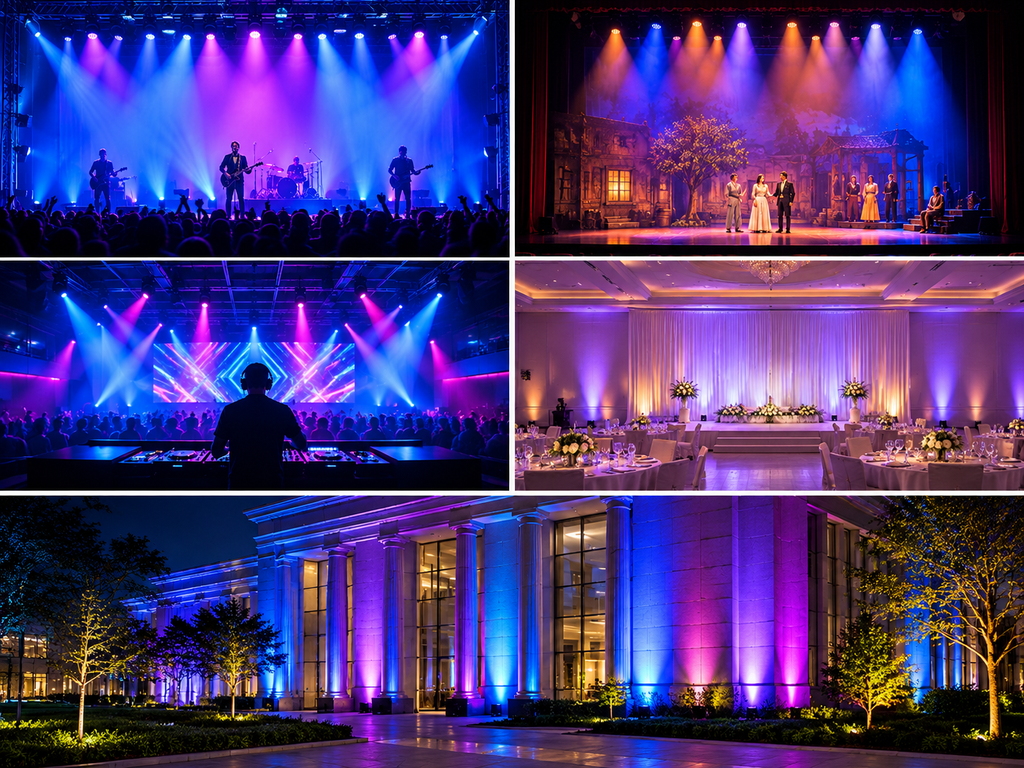
The right stage colors depend on the production rather than a universal list of color meanings. The following examples can help narrow the options before testing them with the actual fixtures, performers, costumes, and scenery.
| Color family | Possible applications | What to check |
| Amber and warm white | Warm interiors, sunset effects, welcoming scenes | Skin tones, costume colors, and overall warmth |
| Pale blue | Cool fill light, moonlight effects, atmospheric scenes | Available output and facial detail |
| Deep blue | Night scenes, concert backgrounds, dramatic accents | Reduced transmission and camera shadow detail |
| Red and orange | High-energy concert cues, fire effects, dramatic transitions | Facial visibility and saturated color clipping on camera |
| Green | Nature-inspired scenery, fantasy, stylized effects | Skin, makeup, and costume appearance |
| Lavender and magenta | Dance, concerts, fashion shows, colored backlighting | Subject separation and color balance |
Warm Colors for Stage Lighting
Amber, straw, and orange filters can give a scene a warmer appearance. They may be useful for creating the impression of sunlight, candlelight, a warm room, or a celebratory concert atmosphere.
For drama and theater, a pale warm filter can be more suitable for acting areas than an extremely saturated color because it can preserve more detail in faces and costumes. Deeper warm colors can be reserved for backlighting, scenery, or selected moments.
Blue Gels for Cool and Atmospheric Lighting
Blue stage light gels range from subtle cool tints to highly saturated blue. Pale blue can introduce a cool appearance while retaining more usable light, whereas deep blue can create a stronger visual statement on the stage or background.
Deep filters often transmit less light than pale ones. If a blue scene appears too dark, consider the filter’s transmission, fixture output, beam angle, and placement before simply increasing intensity.
Red, Green, and Purple for Creative Effects
Red, green, purple, and magenta can create strong visual accents in concerts, dance productions, and stylized theatrical scenes. They can also be used to separate the background from the performers or establish a distinctive look for a musical sequence.
Highly saturated colors may change the appearance of skin, makeup, fabric, and scenery substantially. If facial expression or costume detail must remain clear, retain an appropriate key light or adjust the colored light’s intensity and direction.
These color families are starting points rather than fixed rules. Always test the intended palette in the actual venue and review it from the audience’s perspective.
How to Create Stage Light Color Combinations
Effective stage light color combinations need a clear visual hierarchy. Instead of giving every fixture a different saturated color, assign each color a specific job in the scene.
Start with a Base Color
The base color establishes the overall appearance of the stage. It may come from a broad wash, background fixture, or several lights covering the main performance area. Choose a color that supports the scene without making essential details difficult to see.
Add Contrast or Separation
A second color can distinguish performers from the background. For example, a cool background with a warmer key light can help create depth. The contrast can come from color, brightness, direction, or a combination of these factors.
Use Accents Selectively
An accent color is often most effective when it appears at a specific point in the performance. A short change during a musical transition or dramatic reveal can have more impact than leaving every color active throughout the entire show.
| Palette approach | Example | Best suited to |
| Warm and cool contrast | Warm key with a blue background | Drama, presentations, live performances |
| Monochromatic | Several shades of blue | Atmospheric scenes and coordinated visual themes |
| Complementary contrast | Blue and amber | Subject separation and dramatic depth |
| Saturated accent | Neutral base with short red or magenta cues | Concert transitions and musical highlights |
These combinations should be tested rather than accepted as universal formulas. The result changes with the fixture’s output, filter transmission, stage surface, ambient light, and camera settings.
Stage Light Gels vs. LED Color Mixing
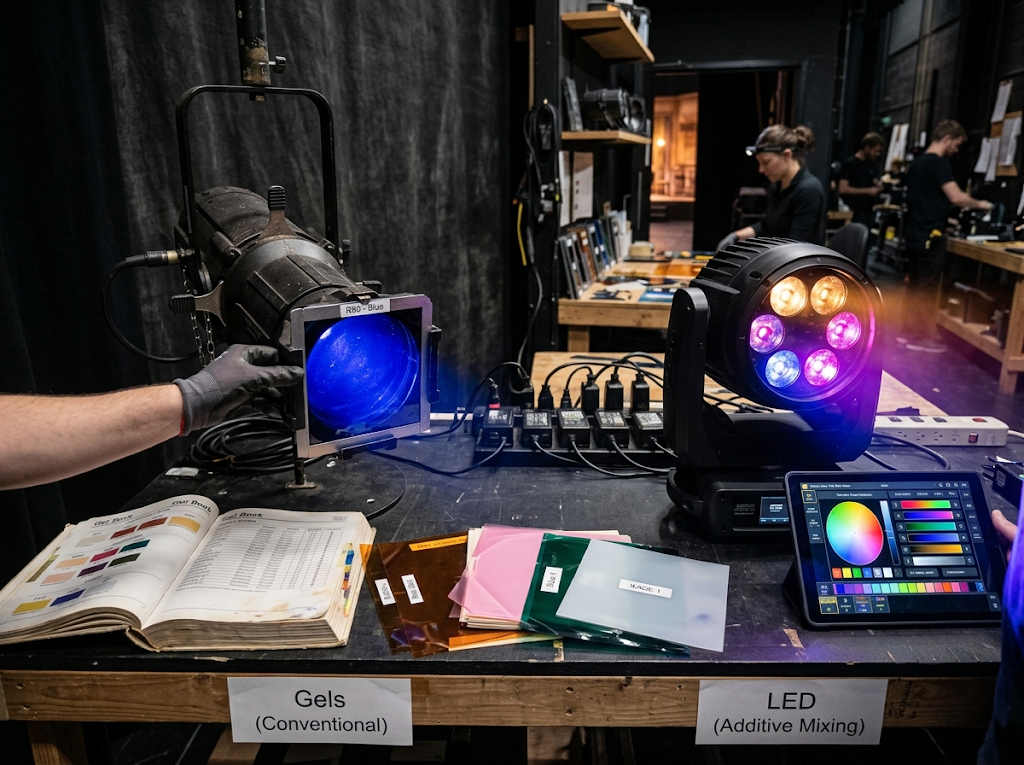
Physical gels and LED color mixing can both create colored stage lighting, but they work in different ways. Understanding the difference helps determine which approach suits a particular production.
How Physical Color Filters Work
A physical gel filters the light produced by a source. It absorbs some wavelengths and transmits others. As a result, the light reaching the stage has a different spectral distribution and a lower total output than the unfiltered source in many applications.
Stacking filters can reduce output further. Two filters should not be assumed to mix colors in the same way as two colored LED emitters, because the final result depends on the wavelengths each filter transmits.
How LED Stage Lights Create Color
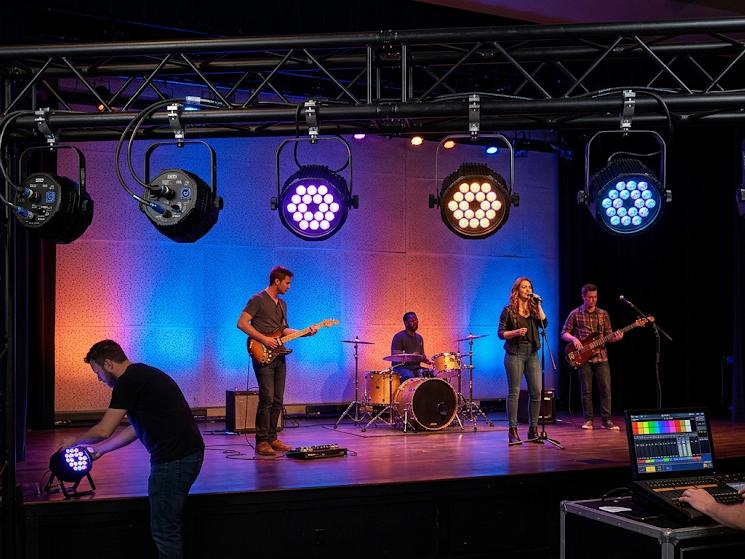
Many full-color LED stage lights create color by combining light from different colored emitters. This is additive color mixing: the output of the emitters combines to produce the perceived color.
With compatible fixtures, users can select colors through the onboard controls or a lighting console. DMX systems can coordinate color changes, intensity, and other supported parameters across multiple fixtures. Learn more in our guide to what a DMX controller does.
LED color performance depends on the fixture’s emitter configuration, optics, output, dimming behavior, and calibration. Different fixtures may not produce identical colors at the same control values, so a real-world test remains important.
Which Approach Is Better?
Physical gels remain useful when working with compatible conventional fixtures, when a specific filter is required, or when the production needs a particular optical effect. LED color mixing is often more convenient when a production requires frequent color changes, repeatable cues, or multiple colors from the same fixture.
The choice depends on the existing equipment, visual requirements, budget, and operating conditions. External filters should only be used when approved by the fixture manufacturer. Never attach an unverified plastic sheet to a hot lamp or modify an enclosed LED fixture to accommodate a loose gel.
For productions that need colored backgrounds rather than individual filter-based beams, explore LED wall wash lights as one possible fixture category.
How to Choose Stage Light Gels for Your Fixtures
Before selecting theatrical lighting gels, check the light source, intended effect, filter transmission, fixture compatibility, and materials being illuminated. These factors help prevent a color that looks good on a screen from producing an unsuitable result on stage.
1. Identify the Light Source
Determine whether the fixture uses a tungsten-halogen lamp, discharge source, white LED, or full-color LED system. Different sources have different spectral characteristics, so the same filter may produce different results.
2. Define the Intended Effect
Decide whether the goal is to warm the light, create a colored background, correct an unwanted tint, soften a beam, or reduce output. This prevents choosing a color-effect filter when a correction or diffusion filter is more appropriate.
3. Check Transmission and Brightness
Review the filter’s published transmission data when available. Deeply saturated filters may pass less light than pale filters, which can affect coverage and brightness at the intended throw distance.
4. Confirm Fixture Compatibility
Check the fixture manual for the approved filter type, frame size, mounting position, ventilation requirements, and temperature limits. Do not assume a filter suitable for one fixture is safe in another.
5. Test the Complete Scene
Test the filter using the actual fixture, performers, costumes, scenery, and production camera. Check facial detail, background separation, reflections, and usable brightness from representative audience positions. A digital color preview cannot reproduce every characteristic of the real light source and filter.
Common Mistakes When Using Theatrical Lighting Gels
- Choosing by color name alone: Two filters with similar names can have different transmission characteristics and visual results.
- Ignoring output loss: A saturated filter may reduce usable light enough to affect coverage and visibility.
- Stacking filters without testing: Multiple filters can substantially reduce output and may not produce the expected mixed color.
- Using incompatible materials: Unverified plastic, craft film, or adhesive sheets may deform or create a hazard near a hot fixture.
- Ignoring skin and costume appearance: Strong colored light can obscure facial detail and change how materials look.
- Assuming every LED fixture needs a gel: Full-color LED fixtures often provide built-in color mixing, and external filters may be unnecessary or incompatible.
Good stage lighting depends on the complete system, not simply the color of a filter. Fixture choice, placement, output, control, and testing all contribute to the final result.
Frequently Asked Questions
What are stage light gels made of?
Many theatrical lighting gels are made from dyed or coated polyester and related filter materials. Dichroic filters use coated glass and work differently from conventional plastic filters. Always check the specifications and temperature limits of the exact product.
Can you use theatrical lighting gels with LED stage lights?
Some LED fixtures support approved external filters for color correction or diffusion. Many full-color LED fixtures generate colors internally. Check the fixture manual before installing any external material.
Do stage light gels reduce brightness?
Yes, physical filters absorb some of the light passing through them. The amount of output loss depends on the filter’s transmission characteristics and the source. Check the filter data and test the fixture at the required throw distance.
What are the best stage light color combinations?
There is no single best combination for every performance. A warm key with a cool background, a monochromatic palette, or a neutral base with a saturated accent can all work when they suit the production and preserve the visibility required by the audience.
Are stage lighting gels reusable?
Undamaged filters can often be reused if they remain compatible with the fixture and retain the required color. Inspect them for fading, warping, bubbles, cracks, or heat damage before each installation.
Should I use gels or LED color mixing for concert lighting?
The choice depends on the fixture system and production requirements. Gels can suit compatible conventional fixtures and specific filtering needs, while LED color mixing can be more convenient for programmed color changes and repeatable cues. Test the actual equipment before making the decision.
Choose the Right Color Approach for Your Stage
Stage light gels remain a useful tool for shaping color, correcting light, and adjusting beam quality when the fixture is designed to accept them. The most effective choice starts with the desired visual result, then considers the source, transmission, compatibility, and materials on stage.
For productions that require frequent color changes, coordinated cues, or broad colored coverage, modern LED stage lighting can offer another approach. Tealshine provides stage lighting solutions for different performance environments. Explore our product range to compare fixture types and identify options that match your lighting design and control requirements.