Professional High Quality Stage Lighting Manufacturer


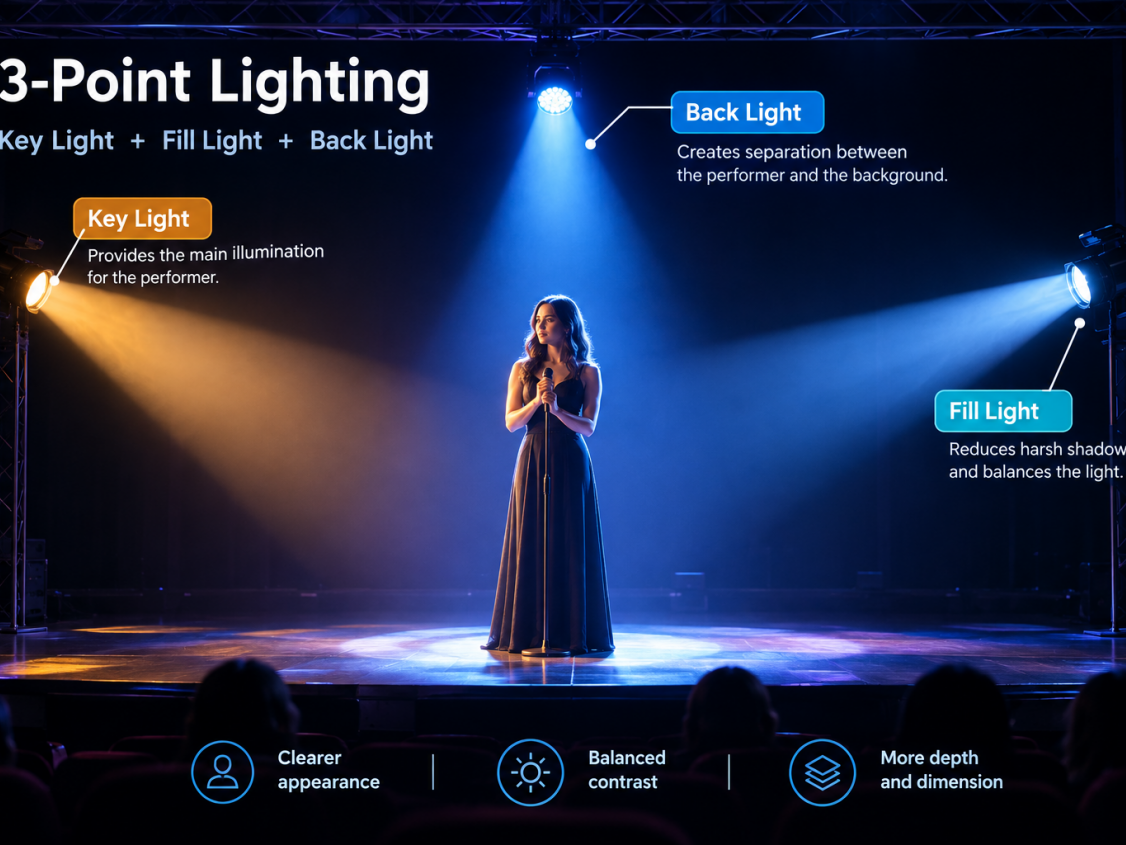
Table of Contents
If you have ever watched a theater performance, concert, live event or studio production and wondered why the performer looks clear without the stage feeling flat, 3-point lighting is one of the basic lighting techniques behind that result.
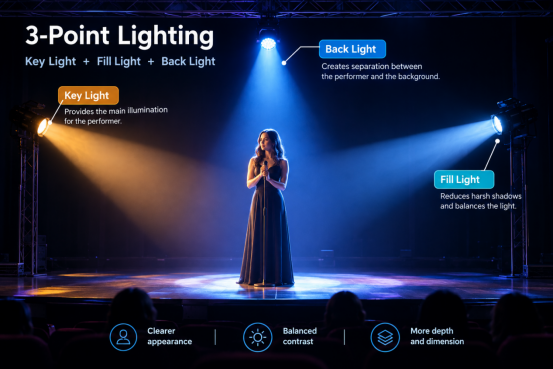
A standard three-point lighting setup uses three lighting positions: key light, fill light and back light. The key light provides the main illumination, the fill light controls shadows, and the back light separates the performer from the background.
Although the concept is simple, a practical 3-point lighting setup for stage is not just about placing three lights around a person. Fixture type, beam angle, mounting height, throw distance, brightness and the performer’s movement all affect the final result.
What Is 3-Point Lighting?
3-point lighting, also called three-point lighting, is a lighting technique that uses three main lighting positions to illuminate and shape a subject.
The three positions are:
- Key Light: the main light that illuminates the performer.
- Fill Light: a softer light that reduces harsh shadows created by the key light.
- Back Light: a light placed behind the performer to create separation from the background.
The idea can be used in photography, video production, theater, concerts, presentations and live events. On a stage, however, the setup often needs to cover more movement and a larger performance area than a traditional studio arrangement.
That is why stage lighting designers may use several fixtures to perform the same three lighting roles across a wider area.
What Are the Three Lights in 3-Point Lighting?
1. Key Light
The key light is the main source of illumination in a three-point lighting setup.
Its primary job is to make the performer visible and give the face and body some shape. Instead of placing the fixture directly in front of the performer, the key light is usually positioned slightly to one side and above eye level.
This creates a more natural difference between the illuminated and shadowed sides of the performer.
A key light that is too high can create unwanted shadows around the eyes. A key light that is too low can create an unnatural appearance. If the fixture is too close or too powerful, the performer may also appear overexposed.
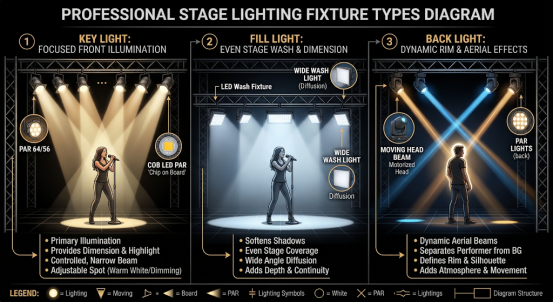
For a stage application, the key light can be created with different fixture types depending on the venue and throw distance. PAR fixtures are useful for fixed coverage, while moving head wash fixtures can reposition the coverage when the performance area changes.
Explore Tealshine PAR Can Lights
2. Fill Light
The fill light works with the key light rather than replacing it.
When a strong key light comes from one side, the opposite side of the performer can become noticeably darker. The fill light adds controlled illumination to that shadow area.
The important point is that the fill light normally does not need to be as intense as the key light.
If the fill light is equally bright, the lighting can become too flat because the difference between light and shadow disappears. If it is too weak, the shadow may remain distracting.
On a stage, a wider wash fixture can be useful for fill lighting because it can cover a larger movement area without creating an excessively narrow hotspot.
3. Back Light
The back light is positioned behind the performer, usually above head level, and aimed toward the performer from the rear.
Its main purpose is not simply to make the performer brighter. It creates visual separation between the performer and the background.
A well-positioned back light can highlight the shoulders, hair and outline of the performer, making the subject easier to distinguish from a dark stage or similarly colored background.
The back light should normally be aimed carefully. If it points directly toward the audience, it can create glare. If it is too strong, it can become more noticeable than the performer.
How Does 3-Point Lighting Work on a Stage?
The basic principle is straightforward:
| Three-Point Lighting Roles | ||
| Lighting Position | Main Purpose | Typical Result |
| Key Light | Main illumination | Clear performer visibility and facial detail |
| Fill Light | Shadow control | Softer contrast and more balanced illumination |
| Back Light | Subject separation | More depth and a clearer performer outline |
In a small setup, one fixture may cover each role. In a larger theater or concert, several fixtures may be assigned to the same role.
For example, a stage may have several PAR fixtures providing key light across the front of the performance area, while additional wash fixtures provide fill and moving heads provide rear or overhead effects.
In other words, 3-point lighting is a lighting concept rather than a requirement to use exactly three physical fixtures.
What Is a 3-Point Lighting Setup for Stage?
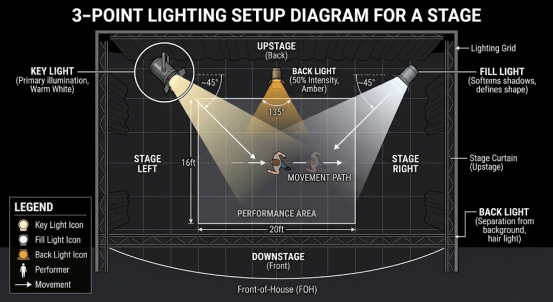
A practical 3-point lighting setup for stage needs to account for the actual movement of performers.
In a studio, the subject may stay in one place. On stage, a singer, actor, dancer or speaker can move several meters during a performance.
That changes the way the three lighting positions need to be designed.
Key Light Position
The key light is normally placed toward the front of the performer and slightly to one side.
For a wider stage, several fixtures can be used across the front lighting position instead of relying on a single fixture.
The goal is to avoid a situation where the performer looks correctly lit in one position but falls into a dark area after moving two or three steps.
Fill Light Position
The fill light is placed on the opposite side of the key light.
It should provide enough coverage to reduce harsh shadows without competing with the key light.
Beam angle is particularly important here. A narrow beam may illuminate only a small area, while a wider beam can provide smoother coverage across a larger section of the stage.
Back Light Position
The back light is placed behind the performer and normally raised above head height.
On a large stage, several rear fixtures may be required to maintain consistent separation as the performer moves.
Moving head fixtures can also be useful when the rear lighting position needs to change during different scenes or cues.
What Is the Difference Between Key Light, Fill Light and Back Light?
The easiest way to understand the difference is to look at what each light is trying to solve.
| Key Light vs Fill Light vs Back Light | |||
| Light | Position | Primary Function | What Happens Without It? |
| Key Light | Front / front-side | Illuminate the performer | The performer may be too dark |
| Fill Light | Opposite side | Control shadows | One side may look excessively dark |
| Back Light | Behind / above | Create separation | The performer may blend into the background |
These three functions can be adjusted independently. That is what gives a lighting designer control over contrast, depth and visual focus.
What Lights Are Used for 3-Point Lighting?
There is no single fixture that must be used for every three-point lighting setup.
The right fixture depends on the size of the stage, throw distance, beam angle, required color, mounting position and whether the lighting needs to move during the performance.
| Common Fixtures for Three-Point Stage Lighting | ||
| Fixture Type | Possible Role | Why It Can Work |
| PAR Can Light | Key / Fill / Back | Fixed, directional stage wash with straightforward positioning |
| Wash Moving Head | Key / Fill / Back | Wide coverage with motorized positioning |
| Beam Moving Head | Back / Effect | Narrow, concentrated effects and aerial beams |
| LED Bar | Background / Back | Linear lighting for scenery and background surfaces |
For basic performer illumination, PAR and wash fixtures are often more practical than narrow beam fixtures. Beam moving heads are generally better suited to visual effects and concentrated rear lighting rather than replacing the main key light.
Tealshine’s current stage lighting range includes PAR Can Lights, Moving Head Lights, LED Light Bars, Wall Wash Lights and Battery Powered LED Lights, giving lighting designers several fixture formats for different roles. View the full Tealshine stage lighting range.
Can PAR Lights Be Used for 3-Point Lighting?
Yes. PAR lights can be used for key light, fill light and back light, particularly when the stage requires fixed and repeatable coverage.
A PAR fixture can be mounted on a truss, lighting stand or other suitable structure and aimed at the required area. Multiple fixtures can then be spaced across the stage to create more even coverage.
Beam angle becomes important when multiple PAR fixtures are used. A narrow beam can leave gaps between fixtures, while a wider beam can overlap more easily.
Tealshine’s own PAR setup guide uses spacing, beam angle and overlap as the main factors when planning PAR coverage rather than simply counting the number of fixtures.
Can Moving Head Lights Be Used for 3-Point Lighting?
Yes, but their value comes from their ability to reposition the light.
A fixed PAR light stays aimed at the same area after installation. A moving head can pan and tilt during the show, allowing the lighting designer to change the direction of the beam through programmed cues.
This makes moving head wash fixtures particularly useful when the performer moves between different stage areas or when the lighting design changes between scenes.
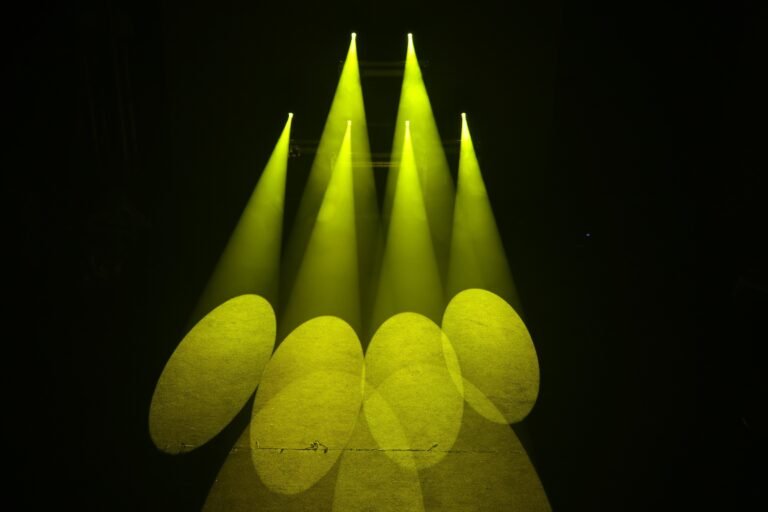
Beam moving heads serve a different purpose. They create a narrower, more concentrated beam and are commonly used for aerial effects, sweeps and dynamic visual elements.
Tealshine’s current moving head range includes beam and wash formats, with products such as the 150W LED Beam Wash Moving Head providing a 3° beam angle.
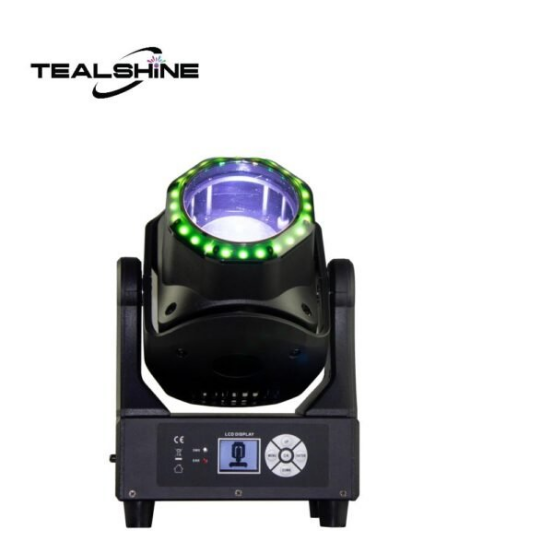
150W LED Beam Wash Moving Head
A 150W RGBL moving head designed around a concentrated 3° beam, suitable for dynamic stage lighting applications where controlled direction and movement are required.
What Is the Best Light for Key, Fill and Back Lighting?
There is no universal fixture that is best for every three-point lighting setup. The correct choice depends on what the lighting position needs to accomplish.
Best Fixture Type for Key Light
For key lighting, the priority is normally clear and controlled illumination rather than dramatic effects.
PAR lights, COB PAR fixtures and wash fixtures can all be considered depending on the stage size and desired beam shape.
The key question is not simply “How many watts does the fixture have?” but rather:
How much of the performance area needs to be illuminated, from what distance, and with what beam spread?
Best Fixture Type for Fill Light
Fill lighting generally benefits from smooth and even coverage.
A wider wash fixture can reduce harsh shadows without creating a small, obvious hotspot. The fill fixture is also normally run at a lower intensity than the key light.
Best Fixture Type for Back Light
Back lighting has more flexibility.
A PAR light can provide a stable rear wash, while a moving head can add movement and change the direction of the rear light during the performance.
How Does Beam Angle Affect 3-Point Lighting?
Beam angle describes how widely light spreads from a fixture.
This is particularly important in stage lighting because the same fixture can cover very different areas depending on its distance from the performer.
| Beam Angle and Stage Coverage | ||
| Beam Angle | Typical Coverage | Possible Use |
| Narrow | Small, concentrated area | Focused backlight or long-throw effects |
| Medium | Balanced coverage | Key or fill lighting |
| Wide | Larger illuminated area | Fill light, backdrop and general wash |
For example, if a fixture is mounted far away from the stage, a narrow beam may cover only a small part of the performer. A wider beam can cover more area but may produce less concentrated intensity.
This is why beam angle, mounting distance and fixture output should always be considered together.
For projects that require specific optical behavior, Tealshine also provides optical customization for different stage lighting requirements. Learn about stage lighting optical customization.
What Is the Ideal 3-Point Lighting Ratio?
There is no fixed lighting ratio that works for every stage.
In a simple three-point lighting setup, the key light is normally stronger than the fill light. This creates enough contrast to give the performer shape while keeping the shadow side visible.
A common starting concept is:
- Key Light: strongest primary illumination.
- Fill Light: lower intensity to soften shadows.
- Back Light: controlled separately according to the desired separation and stage atmosphere.
The actual levels should be adjusted according to the performer, costume, background, camera requirements and ambient lighting.
A bright white costume against a dark background requires a different balance from a dark costume against a bright LED screen.
How Do You Set Up 3-Point Lighting on Stage?
Step 1: Define the Performance Area
Start by identifying where the performer will actually move.
Do not design the lighting around a single mark if the performer will walk across the stage. Define the main movement zone first.
Step 2: Position the Key Light
Place the key lighting toward the front of the performance area and slightly to one side.
Check the performer’s face from the audience position rather than judging only from beside the fixture.
Step 3: Add the Fill Light
Place the fill light on the opposite side and lower its intensity.
Walk through the performance area and check whether the shadow side remains reasonably visible.
Step 4: Add the Back Light
Place the back light behind and above the performer.
Avoid aiming it directly toward the audience. Adjust the angle until the performer separates from the background without creating distracting glare.
Step 5: Test Performer Movement
Ask the performer to move through the actual performance area.
Watch for dark spots, sudden changes in brightness and areas where the key light no longer covers the performer.
Step 6: Adjust Beam Angles
If coverage is uneven, do not immediately add more fixtures.
First check fixture spacing, beam angle, mounting height and aiming direction. A small change in angle can sometimes solve a coverage problem without increasing fixture count.
Step 7: Check the Audience View
Finally, watch the lighting from several audience positions.
A lighting setup can look balanced from the stage but create glare or uneven coverage from the audience area.
3-Point Lighting for Different Stage Applications
3-Point Lighting for Theater
Theater lighting usually places a strong emphasis on performer visibility, facial expression and controlled contrast.
PAR and wash fixtures can provide the basic key and fill coverage, while additional rear lighting helps separate actors from scenery and backdrops.
Because actors move through different areas during a scene, the lighting should normally cover a zone rather than one exact standing position.
3-Point Lighting for Concerts
Concert lighting is more dynamic.
The basic key, fill and back lighting concept can still be used, but moving heads, color changes, beams and effects may be added around it.
A singer may need stable front illumination while moving beams and rear fixtures create visual movement behind the performer.
3-Point Lighting for Dance
Dance performances require the lighting to cover body movement rather than just the face.
Side and rear lighting can be particularly important because they help define body lines and movement.
Wide wash coverage can also help prevent dancers from moving outside the illuminated area.
3-Point Lighting for Corporate Events
For corporate presentations, conferences and speeches, the priority is often clean and consistent illumination.
Excessive movement, strong beams or fast color effects may not be necessary. A controlled key and softer fill can provide a more professional appearance, while background lighting can add separation from the stage backdrop.
3-Point Lighting for Weddings and Events
For weddings and mobile events, flexibility can be more important because the lighting may need to be installed and removed quickly.
Battery-powered PAR fixtures can be useful for areas where running power and signal cables is inconvenient, while conventional PAR and wash fixtures can provide the main stage coverage.
Common 3-Point Lighting Problems and How to Fix Them
Problem 1: The Key Light Is Too Bright
If the key light is too intense, the performer’s face may lose detail.
Reduce the output first, then check whether the fixture needs to be moved or whether a different beam angle would produce better coverage.
Problem 2: The Fill Light Is Too Strong
When the fill light is as strong as the key light, the lighting can become flat.
Reduce the fill intensity and check whether some shadow remains on the opposite side of the face or body.
Problem 3: The Back Light Creates Glare
A rear fixture pointed toward the audience can create uncomfortable glare.
Raise the fixture, change the aiming angle or reduce its output until the performer remains separated without the light becoming distracting.
Problem 4: The Performer Moves Outside the Lighting Area
This is one of the most common problems with a stage-based three-point setup.
The solution may be to widen the beam angle, reposition the fixtures, increase overlap between fixtures or use moving heads where dynamic repositioning is required.
Problem 5: The Stage Looks Flat
A stage can look flat when the key, fill and background are all illuminated at nearly the same intensity.
Creating controlled differences between the front, side, rear and background lighting can add depth without requiring more fixtures.
3-Point Lighting vs. General Stage Lighting
3-point lighting should not be treated as a complete stage lighting design by itself.
It is better understood as a basic lighting framework.
A full stage lighting system may also include:
- Front wash
- Side light
- Backlight
- Top light
- Backdrop wash
- Moving head effects
- Beam effects
- LED bar effects
- Audience lighting
The three-point concept focuses primarily on how light shapes the performer. A complete stage lighting design also considers the background, scenery, audience, atmosphere, transitions and visual effects.
Can 3-Point Lighting Be Customized for Different Projects?
Yes. Professional stage lighting systems often need to be adapted to the venue, fixture position and visual requirements rather than following one fixed setup.
For distributors, rental companies and project contractors, customization can also extend beyond fixture selection.
Depending on the project, an OEM/ODM stage lighting manufacturer may customize:
- LED configuration
- Beam angle
- Optical components
- Power supply
- Housing structure
- Cooling system
- DMX functions
- Firmware
- Branding
- Packaging
Tealshine provides OEM/ODM stage lighting manufacturing for distributors, wholesalers, rental companies and entertainment projects, including customization of optical systems, internal structures, software, chassis design and private-label packaging.
Explore Tealshine OEM/ODM Stage Lighting Manufacturing
Frequently Asked Questions About 3-Point Lighting
What does 3-point lighting mean?
3-point lighting is a lighting method that uses a key light, fill light and back light to illuminate a performer, control shadows and create separation from the background.
What are the three lights in 3-point lighting?
The three lights are the key light, fill light and back light. The key light provides the main illumination, the fill light reduces shadows, and the back light separates the performer from the background.
What is a key light in stage lighting?
A key light is the primary light used to illuminate the performer. It is normally positioned toward the front or front-side of the performance area.
What is a fill light used for?
A fill light reduces excessive shadows created by the key light. It is normally softer than the key light so that some contrast remains.
What is a back light in stage lighting?
A back light is positioned behind the performer and is used mainly to create separation between the performer and the background.
Can you use PAR lights for 3-point lighting?
Yes. PAR lights can be used for key, fill and back lighting when their beam angle, output and position are appropriate for the stage.
Can moving head lights be used as key lights?
Yes. Moving head wash fixtures can provide adjustable key lighting when the performer or performance area changes position. Their pan and tilt functions also make them useful for programmed stage lighting.
Does 3-point lighting work for concerts?
Yes. The basic key, fill and back lighting concept can be used in concerts, although larger productions usually combine it with moving heads, beams, wash fixtures and other effects.
Does 3-point lighting work on a small stage?
Yes. A small stage may only require a few fixtures to create the three basic lighting functions. The main considerations are fixture position, beam angle, brightness and the size of the performer’s movement area.
What is the difference between three-point lighting and stage lighting?
Three-point lighting is a specific lighting technique based on key, fill and back lighting. Stage lighting is a much broader system that can include front light, side light, backlight, wash, beam, moving heads, LED bars and other effects.
Final Thoughts
3-point lighting is a simple lighting concept, but it provides a useful starting point for designing stage illumination.
The key light makes the performer visible. The fill light controls shadows. The back light adds separation and depth.
Once those three roles are understood, the lighting designer can choose the appropriate fixtures based on the actual venue and application.
For a small stage, fixed PAR lights may be enough. For a larger production, wash moving heads can provide repositionable coverage, while beam fixtures and LED bars can add additional visual effects.
The most important point is that the fixture should match the lighting job. Beam angle, throw distance, mounting position, output, movement and control all affect how the final stage lighting looks.
That is what turns a basic three-light concept into a practical stage lighting system.