Professional High Quality Stage Lighting Manufacturer


Table of Contents
A set of 20 battery operated uplights rented for one wedding reception costs somewhere around $200–400 for the night — depending on your market, the supplier, and whether setup labor is included. Buying that same set of 20 outright might cost $3,000–5,000 depending on spec. If you’re running battery operated uplighting at two events a month, the math on that crossover is straightforward. If you’re doing one event every six months, it isn’t. This guide runs the numbers for both sides honestly — including the costs that don’t show up in the headline price — and gives you a clear framework for which answer fits your situation.
The Real Cost of Renting Battery Operated Uplights
Rental pricing for led uplights battery operated typically gets quoted per fixture per day, or as a full set for an event. The headline number is only part of the picture. Before you can compare it against ownership, you need to add:
- Delivery and pickup fees — many rental suppliers charge separately for logistics, particularly for events outside a tight local radius. On a typical wedding job, this can add $50–150 to what looked like a $200 rental quote.
- Setup labor — some rental quotes include a technician placing and powering on fixtures; others expect the client or planner to handle it. If labor is billed separately, confirm the rate and the estimated time before signing off on a quote.
- Damage deposits and insurance — rental companies routinely hold a credit card deposit against damage, loss, or late returns. This isn’t money you spend, but it ties up a card limit for several days around each event.
- Availability risk — during peak season (spring and fall weekends), your preferred rental supplier may already have their inventory committed to other events. Renting means accepting some probability that what you want isn’t available when you need it.
When Renting Makes Sense
Renting is almost always the right answer when two conditions apply together: you use uplighting fewer than four to six times a year, and you don’t have a consistent, predictable event schedule. If uplighting is an occasional add-on rather than a regular line item in your business, owning $4,000 worth of fixtures that sit in storage most of the time is a poor return on capital.
It also makes sense when you need a one-time larger set than you’d normally own — renting 40 fixtures for a single large event is far more practical than buying them for one job and figuring out where to store them afterward.
The Real Cost of Buying Battery Operated Uplighting
Purchase price is also not the whole story. Add these to your ownership calculation:
- Carrying cases and transport — professional-grade fixtures need proper cases to survive repeated transport. A road case for 20 uplights adds $200–600 to the effective purchase cost, depending on case quality.
- Storage space — 20 fixtures in road cases take up meaningful floor space. For planners operating out of a home office or small studio, this is a real constraint, not an afterthought.
- Charging infrastructure — you need somewhere to charge 20 units before each event. If fixtures have non-removable batteries, all 20 have to be physically present and plugged in 8–12 hours before load-in. Confirm your setup has the outlet capacity to handle that without pulling more current than a circuit can support.
- Battery replacement over time — lithium-ion packs are commonly rated for 500–800 full charge cycles before capacity noticeably fades. For fixtures used 2–3 times a week, that works out to roughly 3–5 years before batteries need replacing — a real cost to factor into long-term ownership calculations.
- Maintenance and repairs — owned fixtures that fail are your problem to diagnose and repair or replace. Rented fixtures that fail are returned to the supplier and swapped.
When Buying Makes Sense
Ownership pays off when uplighting is a consistent, frequent part of your business — typically at a threshold of somewhere around six or more events per month where the same fixture set gets used. At that frequency, rental fees compound quickly past what a purchase would have cost, and owning eliminates the availability, logistics, and scheduling friction that grows with how often you rent.
It also makes sense if you’re selling uplighting as a service line at a markup — owning the fixtures means the margin on each event is yours rather than split with a rental supplier. For a planner charging $500–800 per event for uplighting as a service, the ROI math on ownership changes substantially compared to buying fixtures just for personal use.
The Break-Even Calculation: Running the Actual Numbers
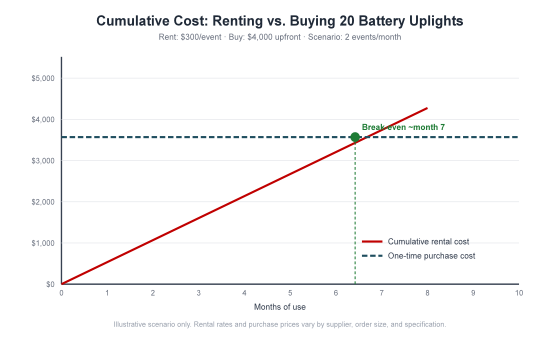
Illustrative scenario. Actual break-even depends on your rental rate, purchase cost, and event frequency — run the same formula with your real numbers: (Purchase price) ÷ (Rental cost per event) = number of events before buying is cheaper.
Two important adjustments to that simple formula:
- Add the hidden ownership costs — cases, charging, storage, and eventual battery replacement. In the example above, these might add $500–800 to the effective ownership cost, pushing the real break-even closer to month 9 or 10, not month 7.
- Subtract the hidden rental costs — delivery fees, labor, and the implicit cost of scheduling friction. If every rental job requires coordinating pickup/delivery logistics, factor the time cost in too, not just the dollar figure on the invoice.
The Middle Path: Partial Ownership
Many event professionals land on a hybrid model rather than a binary choice: own a core set of fixtures that covers routine events (typically 8–12 units), and rent supplemental fixtures for larger jobs that exceed that core set. This approach keeps the capital outlay and storage footprint manageable while still generating a return on owned inventory across most events.
The threshold for the core set is usually whatever covers your most common single event without renting — if 80% of your events need 10–12 uplights and 20% need 20+, own 12 and rent the rest when needed.
For Rental Companies Buying in Volume: Going Direct to Manufacturer
If ownership is the right call, the next decision is where to buy. Retail lighting dealers and distributors add a margin on top of the manufacturer price — for a first-time purchase of a few fixtures, that’s often fine. For a rental company adding 40–60 units to inventory at once, going direct to a manufacturer for an OEM or wholesale price removes that margin layer entirely and can meaningfully change the purchase math.
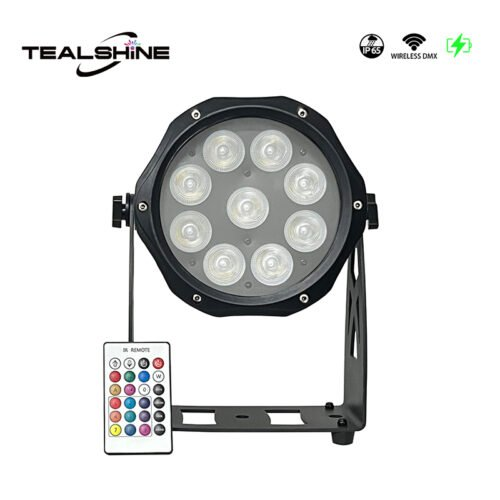
Direct manufacturing relationships also open options that a retail purchase doesn’t: custom LED bead selection, logo branding on the housing, color-temperature specifications that match an existing inventory, or firmware customization to match your DMX console profile. Tealshine’s OEM/ODM services cover all of this directly, and the per-unit price at volume is typically lower than any retail channel for the same specification.
Before You Decide: A Quick Checklist
| Question | If Yes → Rent | If Yes → Buy |
| Events per month using uplighting? | Fewer than 4–5 | 6 or more |
| Consistent, predictable schedule? | No — irregular demand | Yes — regular bookings |
| Charging and storage available? | No easy setup | Yes, space and outlets available |
| Uplighting charged to clients as a service? | No — personal/occasional use | Yes — recurring revenue line item |
| Need fixtures at short notice? | Yes — availability uncertainty | No — plan in advance |
Frequently Asked Questions
How often do I need to use uplighting before buying makes financial sense?
A rough rule: if you’re renting uplighting for six or more events per month consistently, purchasing usually pays off within a year when you include the hidden costs on both sides. Fewer than four events a month, renting typically makes more sense unless uplighting is a billable service line at a meaningful markup.
Can I rent battery operated uplights and then buy the same model later?
Yes, and trying before buying is one of the better arguments for renting a few times first. Running a set through real event conditions lets you verify runtime, wireless range, and control behavior before committing to a full purchase quantity.
What specifications matter most when buying battery operated uplights for long-term ownership?
Battery cycle rating (500–800 full cycles is typical for professional lithium-ion), IP rating (IP54 or higher if any outdoor use is expected), housing material (aluminum die-cast survives repeated transport better than plastic), and wireless DMX reliability over the range you actually need. Full spec breakdown in our battery powered uplighting buying guide.
Is it worth buying battery uplights for a single one-time event?
Almost never. A one-time event is exactly what rental inventory exists for — the per-event rental cost is a fraction of the purchase price, and you avoid owning equipment you have no further use for after the event.
What’s the difference between renting from a rental house vs. buying wholesale direct?
Renting from a local rental house includes logistics, damage protection, and no capital commitment. Buying wholesale direct gives you ownership, a lower per-unit cost at volume, and in some cases customization options that retail doesn’t offer — but none of the rental house’s flexibility or risk mitigation.
Final Thoughts
Neither renting nor owning battery operated uplights is the right answer by default — the right answer depends on how frequently you use them, whether uplighting is a revenue line or a personal cost, and whether your physical setup can actually support owning a set. Run the break-even formula with your real numbers, add the hidden costs on both sides, and the answer usually becomes clear.
Browse Tealshine’s battery powered lighting range for spec comparison across all models, or get in touch about wholesale and OEM pricing for rental company inventory builds.