Professional High Quality Stage Lighting Manufacturer


If your event setup still involves running extension cords across a ballroom floor and taping them down with gaffer tape, there’s a faster way. Battery powered up lights eliminate every cable from the uplighting equation — place them anywhere, turn them on, and control the color and brightness from a phone, a wireless remote, or a full DMX console depending on the show’s needs.
This guide covers everything from the hardware inside a battery operated uplight to which control method fits which event type, what IP65 actually protects against, and which Tealshine model fits your specific job — with enough technical detail to make an informed decision, not just a brand comparison.
Table of Contents
What Are Battery Powered Up Lights?
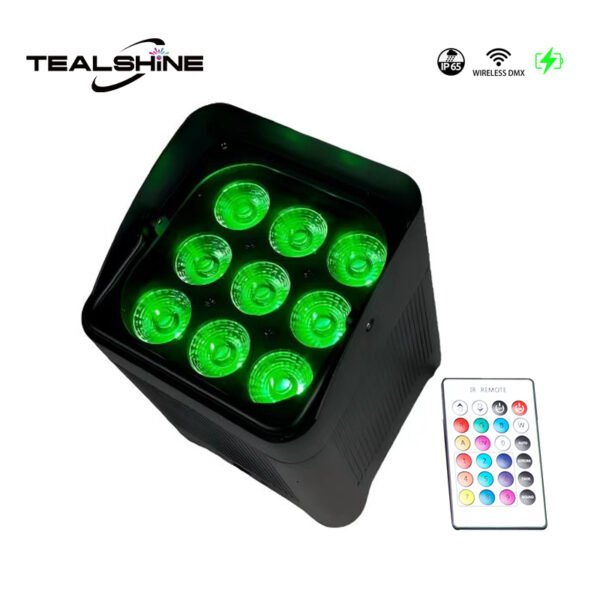
A battery powered up light is a self-contained LED fixture that sits on a floor or a small stand, aimed upward, and washes color across walls, columns, drapery, or architectural features — all without a power cord. The rechargeable lithium-ion battery pack inside the housing replaces the wall outlet, while a built-in wireless receiver replaces the DMX cable.
Most professional-grade wireless uplighting fixtures include all of the following in one unit:
- High-capacity lithium-ion battery pack (8–15 hours rated runtime at full brightness)
- RGBW or RGBWA+UV LED array for full-spectrum color mixing
- Built-in 2.4 GHz wireless DMX receiver (FHSS protocol for interference-resistant control)
- Multiple control modes: DMX, wireless DMX, IR remote, sound-active, and master/slave
- IP65 weatherproof housing for outdoor and tented event use
- Die-cast aluminum housing with rubberized base for stable floor placement
How Battery Powered Up Lights Work
Three systems work together inside every battery powered up light: the power system, the LED output system, and the control system. Understanding each one helps you evaluate whether a fixture will actually perform through a full event day.
Power System: Lithium-Ion Battery + BMS
The battery pack uses lithium-ion chemistry — the same chemistry in professional camera and laptop batteries — for its combination of high energy density (more capacity in less weight) and flat discharge curve (voltage stays relatively stable until the battery is nearly depleted, which keeps LED output consistent across the first and eighth hour of use).
A Battery Management System (BMS) circuit monitors the pack continuously, cutting off discharge before cells drop to damaging voltage levels and cutting off charging before cells exceed their safe maximum. The BMS is what prevents both sudden mid-event shutoffs from over-discharge and the accelerated capacity degradation that comes from improper charging.
Lithium-ion packs are typically rated for 500–800 full charge cycles before capacity drops below 80% of original — for a rental company cycling fixtures twice a week, that works out to 5–8 years of service before battery replacement becomes necessary.
LED Output System: RGBW Array + Constant-Current Driver
The LED array inside a professional uplight uses separate channels for red, green, blue, and white (RGBW) — each driven by an independent constant-current regulator inside the driver circuit. Constant-current driving means the current through each LED channel is held precisely regardless of battery voltage changes during discharge, which is what keeps color consistent through a long event rather than drifting warm or cool as the battery depletes.
RGBW arrays produce cleaner white light and more accurate pastels than RGB-only fixtures, because the dedicated white channel doesn’t rely on mixing red, green, and blue to approximate white — which produces a slightly greenish or magenta-tinted white at most mixing ratios. RGBWA+UV variants add amber and ultraviolet channels for extended color range and UV effects.
Control System: Wireless DMX + Multiple Mode Options
The built-in wireless DMX receiver operates on 2.4 GHz using frequency-hopping spread spectrum (FHSS) — a protocol that rapidly switches transmission frequencies to avoid sustained interference from Wi-Fi networks and other devices in the same band. This is how wireless DMX stays reliable in a crowded event venue where dozens of phones, tablets, and Wi-Fi access points are all competing for spectrum.
Control Methods: DMX, App, Remote, and Sound-Active
One of the most common points of confusion around portable up lights is what control options actually exist and which one fits a specific event. The four main control methods serve different production needs.
| Control Method | How It Works | Best For | Equipment Needed |
| Wireless DMX | 2.4 GHz FHSS signal from transmitter to each fixture | Full production control, zoning, cued shows | Wireless DMX transmitter + controller or console |
| App Control (Wi-Fi/BT) | Smartphone connects to fixture or hub via Wi-Fi or Bluetooth | Small events, no console, color presets | Smartphone + app (brand-specific) |
| IR Remote | Infrared remote within line-of-sight to fixture | Single fixture or small group, simple color selection | Included IR remote handset |
| Sound-Active | Built-in microphone triggers color/effect changes from audio | DJ sets, parties — no control hardware needed | None |
| Master/Slave | One fixture broadcasts settings to others via cable or wirelessly | Synchronized multi-fixture without a console | DMX cable or wireless link between fixtures |
Wireless DMX vs. App Control: Which One to Use
Wireless DMX is the right choice whenever the event has a lighting operator, a console or software controller, and a need for precise, repeatable color cues — corporate events with brand color specifications, theater productions, or concerts where lighting syncs to a cue sheet. It integrates with professional lighting consoles (grandMA, Avolites, etc.) and supports full universe-level control of dozens of fixtures simultaneously.
App control via Bluetooth or Wi-Fi is better suited to events where there’s no dedicated lighting operator — a wedding planner setting color once and walking away, a venue coordinator changing a room’s atmosphere between dinner and dancing. The speed and simplicity of phone-based control trades the precision and programmability of DMX for one-touch color selection and preset management.
One important distinction: app control and wireless DMX are separate systems. A fixture with wireless DMX does not automatically support smartphone control — those are different radio protocols. Confirm which control types a specific fixture model supports before purchasing if app control is a requirement.
Why Choose Battery Powered Up Lights Over Wired Alternatives
The decision between battery operated uplights and wired par cans comes down to four concrete factors — not just the convenience of going cable-free.
Setup Time: The Biggest Practical Difference
A wired uplight requires: positioning the fixture, running a power cable back to an outlet, routing the cable safely (usually along a baseboard or under a floor runner), taping the cable with gaffer tape to prevent a trip hazard, confirming the outlet isn’t overloaded with other fixtures on the same circuit. At 5–8 minutes per fixture for a two-person crew, 20 wired uplights take 90–150 minutes of load-in time.
A battery uplight requires: positioning the fixture and powering it on. At 1–2 minutes per fixture for one person, 20 battery uplights take 20–40 minutes total. That setup time difference compounds across a rental season — a company running two uplighting jobs per week saves several hours of billable crew time per week just from the load-in difference.
Venue Flexibility: Where Cable Routing Isn’t Possible
Many venues — particularly hotel ballrooms, historic buildings, and country clubs — prohibit taped cable runs across walkways and guest areas. Fire marshals in many jurisdictions also restrict cables across egress paths as a trip hazard and egress obstruction. Battery uplights sidestep this entirely: no cable means no venue conversation and no fire marshal check during a walkthrough.
Battery fixtures also reach positions that cable can’t: behind a centerpiece arrangement in the middle of a room, inside a tent at the tent’s peak away from all wall outlets, behind a column in a venue whose outlets are all on one wall. Placement flexibility follows directly from cable elimination.
Cost Over Time: When Battery Pays Back
Battery uplights cost more upfront than wired equivalents. The payback comes from two directions: reduced labor cost per event (setup time difference), and reduced recurring consumable costs (gaffer tape, extension cords, power strips — real per-event costs that wired setups require). For a rental company running six or more uplighting events per month, the labor savings alone typically recover the premium within the first year of regular use. For occasional use (under four events per month), the math often favors renting rather than owning battery inventory.
Top Use Cases for Battery Powered Up Lights
Weddings and Receptions
Weddings are the dominant use case for battery powered up lights in the event lighting industry — and the reasons are specific to how weddings work, not just general convenience. Most hotel and venue ballrooms prohibit taped cables on guest floors. Setup windows are often 60–90 minutes total, shared with caterers, florists, and AV crews. Battery uplights deploy in a fraction of the time of wired alternatives, leave no cable hazards near floor-length gowns and walking guests, and can be placed exactly where the design calls for them — behind a floral arch, at the base of a tent pole — rather than where outlets happen to exist.
For a 150-person reception ballroom, 16–24 battery uplights along the perimeter walls in warm white (2700K–3000K) produces an even, photogenic wash without the color cast that saturated colors introduce into every photo taken against that backdrop.
Corporate Events and Brand Activations
Corporate events have two lighting requirements that battery uplights address directly: brand color accuracy and fast load-in. Event venues often restrict visible infrastructure (cables, stands, cases) in the event space itself, which makes battery fixtures with clean, standalone positioning preferable to wired setups with their associated cable management hardware.
App or wireless DMX control lets a venue coordinator or event manager change the room’s color from a phone without accessing a lighting console or reconfiguring fixtures physically — useful when a space transitions between a keynote presentation in neutral white and a reception in brand color without a crew change.
Outdoor Events, Festivals, and Tented Receptions
Outdoor events combine two challenges that battery uplights solve together: limited power access and weather exposure. A tented event at a garden venue may have generator power limited to catering and sound, with no outlets anywhere near the tent liner positions where uplighting would go. IP65-rated battery fixtures require no power infrastructure at those positions and are sealed against rain, condensation, and heavy dew.
IP65 covers dust-tight housing and water jet resistance from any direction — adequate for direct rain exposure during outdoor events. It does not cover submersion or high-pressure water jets; fixtures sitting in pooled water from flash flooding exceed the IP65 specification. For events in environments with unusually heavy weather risk, positioning fixtures off the ground surface (on small stands rather than floor-mounted) provides additional protection beyond the IP rating alone.
DJ Booths and Club Installs
Battery uplights in a DJ booth context solve the same cable problem at a smaller scale: positioning accent lighting exactly on the booth face, behind the decks, or along the booth’s perimeter without running cables across a dance floor or through a booth structure that wasn’t designed for cable routing.
Sound-active mode is the default control for DJ booth uplights on routine nights — the built-in microphone triggers color changes and intensity pulses from the music without any DMX programming or console involvement. For DJs who want more control over specific looks, master/slave linking syncs multiple fixtures to one master without requiring a full wireless DMX setup.
Architectural and Stage Lighting
Battery uplights work as architectural accent fixtures in spaces where power runs are impractical: illuminating columns, artwork, or structural features in heritage buildings, lighting trees and landscaping at outdoor events, or providing fill light in film and photo shoot locations where wiring infrastructure isn’t available.
For stage applications, battery uplights fill a specific gap: portable, repositionable floor-level wash that doesn’t require a power tie-in to the stage’s power distribution. They’re not a substitute for a full wired stage wash rig, but they extend coverage to positions that a wired rig can’t practically reach.
How to Set Up Battery Powered Up Lights: Step by Step
A standard deployment of portable up lights for a medium reception (16–20 fixtures) follows this sequence:
- Step 1: Charge fully before the event. Standard charging time for most professional fixtures is 5–7 hours from depleted to full. Charge overnight before a daytime event, or the morning before an evening event. Confirm each fixture shows full charge status before packing for load-in.
- Step 2: Walk the room before placement. Identify the usable wall sections (excluding service doors, kitchen exits, and built-in fixtures), measure or estimate the total run, and calculate fixture count using the 8–10 foot spacing rule: one fixture every 8–10 feet for a continuous wash at standard 25°–40° beam angles.
- Step 3: Position fixtures along perimeter walls. Place each fixture at the wall with the lens aimed upward and slightly toward the wall surface — typically 6–12 inches away from the wall face for best coverage.
- Step 4: Set control mode and address. For wireless DMX, set each fixture’s starting DMX address using the onboard menu. For sound-active or master/slave mode, set one fixture to master and configure the rest as slaves. For app control, pair fixtures to the control app per the manufacturer’s pairing sequence.
- Step 5: Set color and confirm consistency. From the controller, app, or console, set the target color and confirm that all fixtures in the run match.
- Step 6: Monitor during the event and note runtime. Professional lithium-ion fixtures hold consistent output until near depletion, then drop rapidly. Know the fixture’s rated runtime and check status at the midpoint of a long event if the event runs close to the rated duration.
Tealshine’s Battery Powered Up Light Range
Tealshine’s battery-powered lineup covers five distinct configurations, each suited to a different output requirement and use case. All five models carry IP65 weatherproofing and include wireless DMX as standard.
| Model | LED Config | Total Power | Best For |
| Versatile Battery Par | 9×18W RGBWA+UV | 162W | Standard reception perimeter wash |
| Wireless Battery Uplighter | 9×18W RGBWA+UV | 162W | Standalone accent, same spec as Versatile Par in uplight housing |
| Advanced Battery Par | 12×18W RGBWA+UV | 216W | Larger venues needing more output per fixture |
| Par Can Spotlight | 16×15W RGBWA+UV | 240W | Long-throw uplighting, large ballrooms |
| Outdoor Battery Light Bar | 18×15W RGBWA+UV | 270W | Linear coverage — stage edges, long wall runs, tent perimeters |
Battery Powered vs. Wired Uplights: Full Comparison
| Factor | Battery Powered | Wired (Plug-in) |
| Setup time (20 fixtures) | 20–40 min, one person | 90–150 min, two-person crew |
| Cable management | No cables required | Extension cords + gaffer tape on every fixture |
| Venue restrictions | No cable-run restrictions apply | Many venues restrict taped floor cables |
| Placement flexibility | Any position, including tent peaks and tree bases | Limited to outlet range + extension cord length |
| Runtime | 8–15 hours at full brightness (fixture-specific) | Unlimited — runs as long as mains power is on |
| Control options | Wireless DMX, app, IR remote, sound-active, master/slave | Wired DMX, sound-active, master/slave (no wireless typically) |
| Upfront cost | Higher per fixture | Lower per fixture |
| Recurring costs | Battery replacement at ~5 years; negligible consumables | Gaffer tape, extension cords — recurring per event |
| Multi-day installs | Requires recharging (impractical for week-long installs) | No limitation |
| Outdoor use | IP65 models — yes | IP65 models — yes (with matching cable/connector rating) |
What to Check Before Buying Battery Powered Up Lights
- Runtime at full brightness — not the eco-mode figure. A fixture rated at 15 hours in a spec sheet may only hit that at 20–30% output. Always ask for runtime at 100% output.
- Wireless control type — wireless DMX and app control (Bluetooth/Wi-Fi) are separate systems. Confirm which the fixture supports if app control is a requirement.
- IP rating — IP65 for outdoor and tented events; IP20 fixtures are indoor-only. Confirm the rating applies to the full housing including connectors, not just the body.
- Housing material — die-cast aluminum handles years of transport better than plastic shells and dissipates heat more effectively.
- Charge cycle rating — 500–800 cycles is standard for professional lithium-ion. Lower ratings mean earlier battery replacement.
- Color mixing — RGBW produces cleaner white and pastels than RGB; RGBWA+UV extends the color range with amber and UV channels.
Frequently Asked Questions
How long do battery powered up lights last on a single charge?
At full brightness, most professional fixtures run 8–15 hours depending on the model and LED configuration. Always verify the manufacturer’s runtime figure is quoted at 100% output rather than eco-mode — the eco-mode figure can be two to three times higher and is not representative of event use.
Can I control battery powered up lights with my phone?
Some models support smartphone control via Bluetooth or Wi-Fi app — but not all battery uplights include this. Wireless DMX (2.4 GHz) is a separate control system from Bluetooth/Wi-Fi app control. Confirm specifically which control modes a fixture supports before purchasing. Tealshine’s battery range supports wireless DMX, IR remote, sound-active, and master/slave modes.
Are battery powered up lights suitable for outdoor events?
Yes, with IP65-rated models. IP65 covers dust-tight sealing and water jet resistance from any direction — adequate for direct rain during outdoor events. It does not cover submersion. All five models in Tealshine’s battery powered range carry IP65 ratings.
How many battery up lights do I need for a 100-person reception?
A typical 100-person reception room has roughly 160 feet of usable perimeter wall. At one fixture every 9 feet (standard spacing for 25°–40° beam coverage), that works out to 16–18 fixtures for a continuous wash. For exact calculations by room size and ceiling height, see our uplight count guide.
What is the difference between wireless DMX and app control for battery uplights?
Wireless DMX transmits DMX-512 control data over 2.4 GHz radio to fixtures, integrating them into a full lighting console or software workflow. App control uses Bluetooth or Wi-Fi to connect a smartphone directly to the fixture or a hub, allowing color selection and scene presets without a console. Wireless DMX is better for multi-fixture precision control; app control is simpler for event staff without lighting backgrounds.
Do battery uplights work with a DMX controller?
Yes. All of Tealshine’s battery powered models include wireless DMX as a standard control mode, compatible with any DMX-512 transmitter and standard lighting console software. For productions that use a full lighting console, wireless DMX allows battery uplights to integrate into the same control universe as any other wired fixture.
Final Thoughts
Battery powered up lights have become the default choice for event uplighting because they eliminate the two biggest logistical headaches in the category — cable management and outlet dependency — without compromising on color quality or control options. The right fixture for a specific job depends on runtime requirement, control method, IP rating, and output level — not just headline wattage.
Tealshine’s battery powered range covers five configurations from 162W to 270W, all IP65-rated, all wireless DMX-capable, and all available in RGBWA+UV color mixing for the broadest color range in the category.